A handful of destinations across the globe appear on virtually every wanderer's shortlist, popping up in films, television programs, and the notebooks of countless travel writers and bloggers. The precise reason escapes me, yet these places undeniably exist, and Lucca belongs squarely to that elite group. Tucked away within Italy's enchanting Tuscan countryside, I first caught wind of Lucca during a broadcast of "House Hunters International." From that moment onward, after countless encounters with its name in print, I longed to experience it firsthand and confirm whether the hype matched reality. That chance finally arrived during a Viking oceans cruise through the Mediterranean, with a port stop in Livorno. Among the optional shore excursions was an independent half-day adventure in Lucca, which I snapped up without hesitation. It proved an ideal and hassle-free way to uncover what, if anything, lies behind the city's enduring magnetism.
Lucca
Like countless Italian settlements, Lucca carries an astonishing lineage, its origins stretching back beyond even Roman times. Hemmed in by peaks, woodlands, and cultivated fields, stepping into Lucca delivers exactly the Tuscan fantasy travelers dream about. Beyond its deep history, Lucca has also retained its significance across the ages. Serving as a nucleus for commerce, faith, and learning, the city has long stood among Tuscany's pivotal urban centers, a role it maintains to this day. Part of why I opted for the independent excursion rather than a guided outing was my desire to wander the city at my own tempo, searching for its hidden pulse. Viking delivered precisely that experience. They handled the logistics, supplied a knowledgeable guide en route who fielded every question thrown his way, then released us to chart our own course upon arrival. On a brisk morning roughly a week before Christmas, wrapped in layers, I struck out down one of Lucca's countless narrow lanes to investigate the buzz for myself.
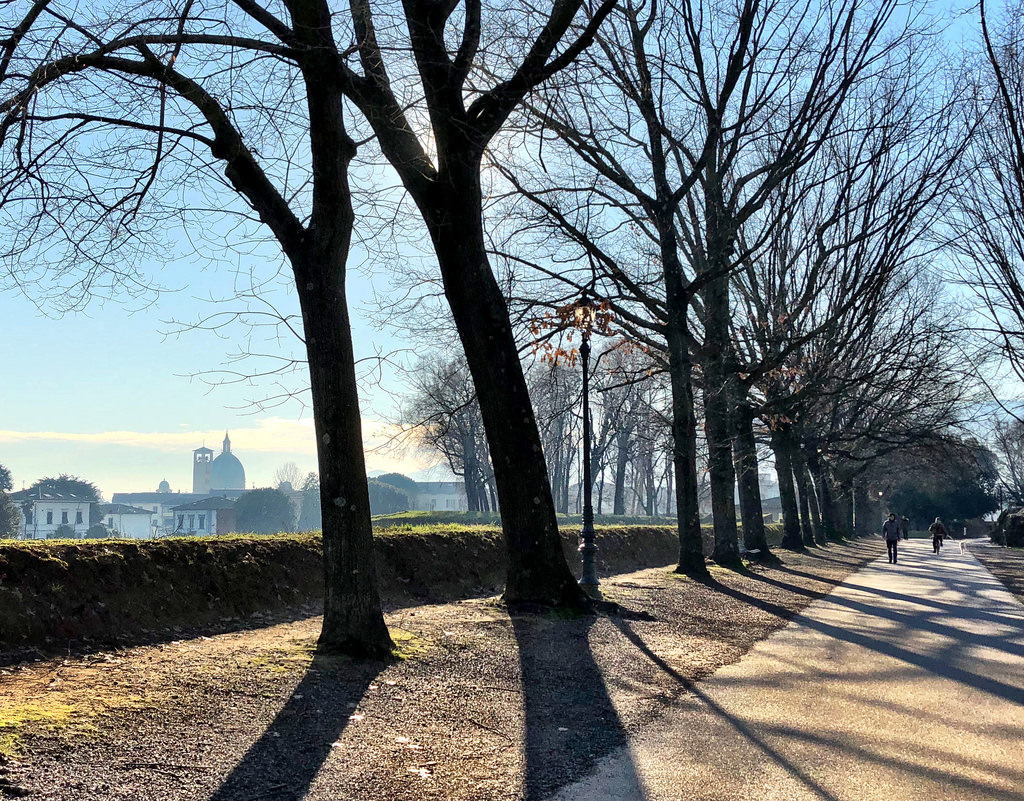
The urban footprint still echoes its medieval origins, and Lucca may be best recognized today for the remarkably preserved fortifications that continue to wrap around its center. Yet these fortifications differ dramatically from any I've encountered elsewhere in Europe. Rather than a slender elevated path crowning the city, Lucca's ramparts form an expansive, park-like promenade suspended above the streets. Functioning more as terraced greenways than defensive barriers, once the city concluded in the 19th century that military protection was no longer required, it pursued a path few municipalities dared. Rather than demolishing them, residents broadened and elevated them. Trees and turf were added, which explains why an unbroken ring of verdant parkland now embraces the entire city. The result is extraordinary and so uncommon that after merely strolling a portion of the walls, I grasped instantly why this feature alone lures so many fascinated travelers.
Lucca, however, offers far more than its celebrated walls, and equipped with a practical map, I eagerly set out to uncover additional layers of the city. Nine o'clock on a Tuscan morning, though, meant I essentially had the place to myself, at least initially. I devoted that window to a preliminary circuit of the historic core, pausing for steaming coffee and sampling a regional bread specialty, an unusually tacky raisin roll crowned with a sharp anise coating. Rays from the rising sun bounced off centuries-old facades, igniting brilliant flashes that bathed the city in a warm, fiery luminance. Passing Roman amphitheaters, open piazzas, and towering houses of worship, I stepped inside several to appreciate the artwork and offer a moment of reverence. In the central piazza, vendors were just beginning to arrange their offerings as the market stirred to life. Yet something nagged at me, since despite the obvious beauty, I hadn't quite bonded with the place, and I certainly couldn't fathom its sudden ascent to travel stardom. So I did what I always attempt when the opportunity arises: I climbed.
I adore capturing elevated perspectives of unfamiliar cities, and my efforts in Lucca paid off handsomely after ascending the 230 steps of the Guinigi Tower. Erected during the 1300s, this ranks among the final surviving towers within the walled perimeter and boasts an unusual characteristic, a rooftop garden adorned with full-grown oak trees. Naturally, though, the panoramas commanded all the attention, delivering an unobstructed 360-degree sweep across Lucca's historic core and the stunning rural landscape encircling it. With nobody else around, my mind drifted into quiet contemplation, a potent reminder of why exploration means so much to me. That was the precise instant Lucca clicked into place, as I stood surveying the whole of it and absorbing the profound gravity of accumulated centuries. I could have lingered up there indefinitely, but biting winds and sub-freezing temperatures drove me swiftly back to the welcoming warmth of the nearest café, where I gradually coaxed sensation back into my fingers with additional coffee and a flaky pastry.
Overall Feel
I occupied that café for an extended stretch, observing the steady stream of patrons while the genuinely gracious proprietor greeted every single one with warmth. Eventually, I spotted the time and hurried toward the central piazza to meet my transport back to the Viking Star. Standing there, I registered how dramatically the city had awakened since my arrival. Crowds now filled the lanes, hunting for final Christmas purchases, selecting centerpieces for holiday feasts, and drifting in and out of neighborhood churches for brief moments of devotion. Tucked along one edge of the piazza sat a mechanical fortune-telling machine, identical to the one immortalized in the film "Big." I couldn't pass it up and fed in a Euro for a reading. The card that emerged bore Italian script, and once translated, one particular phrase struck a chord: "You will go far and see much." It's an uncomplicated sentence, fairly generic, and almost certainly appears on countless identical slips. Yet it was precisely the message I required, a reassurance I desperately needed in that moment. Working independently involves perpetual warfare against self-doubt, and at that juncture, in that setting, the cosmos recognized my need for a tender vote of confidence and delivered accordingly.
I departed Lucca that afternoon peering longingly through the coach window, having genuinely surrendered to the city's spell. Yet it wasn't the fortifications or the sanctuaries that won me over, no, something far more intimate accomplished that. Lucca emerged as a healing encounter for me, reigniting my appreciation for the peculiar career I've fashioned and the drive to explore that has anchored my sense of self since childhood. So absolutely, make time for Lucca when Tuscany calls, but approach it on your own terms. Do it to unlock the influence a stunning location can wield over your spirit, and do it to reconnect with what renders this strange existence so profoundly meaningful.
The post Chasing the Mystery Behind Lucca's Universal Appeal appeared first on LandLopers.