Anyone convinced that the past was somehow gentler — with women in hooped gowns and suitors crooning beneath their balconies — only has half the picture. History is littered with rituals and customs that would horrify even the most unflinching observer in the twenty-first century. A great many of them fell on women, stripping them of dignity and sometimes leaving them permanently disabled. In this piece for GoSeekNest magazine, I'll walk you through:
Historical rituals that wrecked women's health and lives
And here's the unsettling part: a few of these customs are still in use, which is almost impossible to fathom.
1. Chastity girdle
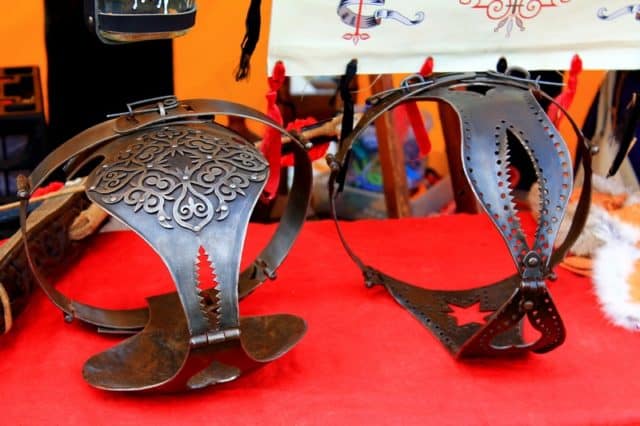
two chastity belts — photo: omnomad.com
Plenty of films have been shot featuring this iron contraption, and it turns up in history museums and period dramas, yet the genuine purpose of the chastity belt remains poorly understood. The widely repeated claim that warriors and knights buckled them onto their wives before departing on long campaigns turns out to be fiction.
The earliest written reference dates to 1405. Some researchers argue the device was originally conceived as a safeguard against sexual assault, but that interpretation is shaky. The context that fits best, scholars say, isn't the medieval period at all but the reign of Queen Victoria — a noted moralist who cracked down on physical intimacy between husbands and wives.
Young women were fastened into chastity belts to prevent adultery and self-stimulation, both of which were branded as mortal sins. A number of them wore the contraptions for their entire lives, even though the metal chafed their skin raw, produced festering wounds, and sometimes triggered sepsis and death.
2. The Virginias
A peculiar custom called "Virginija" held sway for generations across Albania, Montenegro, and Kosovo. Whenever a household produced no sons — or lost all its boys in childhood — one of the daughters, usually the youngest, was chosen to fill the male role. She received a boy's name, had her chest bound flat at puberty, and was assigned tasks traditionally reserved for men.
A sworn virgin was forbidden from speaking of herself in feminine terms, playing with other girls, or engaging in any activity considered women's work. Fellow villagers addressed her as a man and held her parents in deep respect. Many of these women eventually came to view their biological sex as a biological accident. They drank, smoked, swore, brawled, took on male occupations, and — unlike women — were granted voting rights.
Historical practices women were subjected to across different eras
Sworn virgins took a vow of lifelong celibacy. They were issued male identity papers, yet oddly enough, they were not honored with male funeral rites. The last known Montenegrin sworn virgin, Stana Tserovich, passed away on August 1, 2016, aged 85. Reports suggest that roughly 150 individuals linked to this custom still live in Kosovo and Albania.
Women ended up as sworn virgins for other reasons as well. In the rugged highlands, blood feuds were common and could wipe out every male in a family. To keep the family line from vanishing, daughters were converted into "virgins." The same fate was reserved for any girl whose engagement was called off.
3. "Lotus feet"
Elderly Chinese woman with lotus feet
For roughly a century — until the early 1900s — Chinese families deliberately crippled their daughters' feet, striving to make them as small as possible. Starting at around four or five years old, a girl's feet were wrapped tightly, the toes forced down against the sole. The foot kept growing under the bindings, causing constant pain and significant discomfort. By the time she turned ten, the girl had fully developed "lotus feet" — a lifelong disability that was nonetheless seen as a prerequisite for a good marriage.
A foot measuring up to 7 cm was dubbed a "golden lotus," up to 10 cm a "silver lotus," and anything larger "iron." Women lost the ability to walk unaided or to live actively. Many were effectively sentenced to a lifetime in a chair, but were still considered gorgeous, since Chinese standards prized tiny feet, a delicate build, and a tripping step. Prospective grooms wouldn't give a second look to a woman with normal-sized feet.
lotus feet
The wrapping was carried out by the girl's own mother or by a hired specialist. The whole process stretched across two or three years, during which toes routinely snapped and nails dropped off. Trapped in bandages and pointed little shoes, the young woman had to relearn how to walk, often walking several kilometers a day to restore circulation. The weight of the body gradually reshaped the foot.
Ruins Studio is a Home Embedded in the Stony Remains of a Scottish Farm
As time went on, the wrappings were pulled even more tightly, leading to fresh bone fractures. A high arch developed — large enough that a chicken egg could fit between the heel and the toes. Only peasant girls who needed to toil in the fields escaped this fate. Even destitute families tried to provide at least their eldest daughter with bound feet. In that era, Chinese society regarded women as the embodiment of softness and passivity — the "yin" force. Once crippled, a woman became entirely dependent on her family and husband, traits tied to modesty and chastity.
Wealthy men married disabled women to flaunt their own status, since they could afford to spare their wives from housework and walking entirely. Meanwhile, women whose feet had been left normal often blamed their mothers for robbing them of a chance at a desirable marriage. Some sources claim that women with bound feet can still be found alive in China.
4. Corsets
Woman tightens a corset on another woman
For generations, the wasp-waisted silhouette was the height of feminine fashion. To carve out the perfect hourglass, women strapped themselves into corsets built from heavy fabric reinforced with whalebone, cinched ruthlessly tight around the chest and waist. Breathing became an ordeal. The result was a cascade of ailments: displaced organs, cracked ribs, fainting spells, and crushing pressure on the heart and lungs. Corsets were also implicated in miscarriages. It took until the nineteenth century for the medical profession to start sounding alarms about the severe damage these garments inflicted — by which point the toll on young women was staggering.
5. Force-feeding
full Mauritanian
The cult of the voluptuous woman is still very much alive in Mauritania. In this West African country, girls are expected to pack on the pounds from early childhood — by force — to be considered attractive and to secure a husband. Food is scarce, so a full-figured wife serves as a visible sign of prosperity and privilege.
Starting at age eight, girls are force-fed, and any resistance is met with broken toes — inflicted with pliers. Once they hit marriageable age, the girls are sent to a special desert camp where they consume up to 16,000 calories a day. The menu includes crackers drenched in olive oil, bread, figs, goat meat, couscous, and camel milk. The resulting obesity leaves Mauritanian women prone to heart problems and general poor health.
woman feeds a girl from a bowl
To spare themselves the agony of stuffing so much food, some turn to veterinary steroids. These growth-hormone drugs distort the body's proportions — the face, belly, and chest balloon while the arms and legs stay stick-thin. Although the pills cause infertility and heart failure, women see them as a lesser evil compared to force-feeding.
6. Female circumcision
blade on a female palm
The roots of female circumcision stretch back to the Incas, and the practice endures today in pockets of Africa, the Middle East, and Asia. Incidents have also been recorded in France, Germany, Finland, the United States, Latin America, and the United Kingdom. Britain outlawed the procedure in 1985, yet large immigrant communities continue to flout the ban. A UN resolution passed in 2012 has done little to curb the bloodshed. By the numbers, 84 million women across 30 countries have fallen victim to this savage custom.
7 Mystical Points Of The Planet That Remain A Mystery To Scientists
Female circumcision is framed as a way to safeguard a girl's purity, virginity, and fidelity, nipping any sexual impulse in the bud. Adherents also claim it boosts male pleasure during intercourse and carries a religious meaning, though neither the Quran nor the Bible mandates anything of the sort. The consequences can be catastrophic: loss of sexual sensation, depression, blood poisoning, infertility, cysts, fistulas, chronic infections, abscesses, menstrual blood seeping into the abdomen, agonizing pain, and death.
knife in a female hand
Several variants exist. The Sunna form involves removing the labia minora, leaving the clitoris permanently uncovered. Excision is more severe, removing the clitoris entirely and stripping a woman of any chance of sexual pleasure — she becomes "impure" in the eyes of her future spouse. The most extreme version, infibulation or "pharaonic" circumcision, involves stitching the labia majora shut, leaving only a tiny aperture for menstrual blood to escape.
It hardly needs saying that the operation is frequently performed by people with no medical training, in unsanitary conditions, and without any anesthetic. Recovery can take months, with the woman's legs bound together. Only the husband is permitted to "open" her. The procedure is repeated after childbirth, with the area re-sewn. Girls writhe through unendurable agony, lose consciousness from shock, and frequently bleed to death or die of complications.
7. Neck stretching
In Myanmar, the Kayan (Pdaung) people nurture their own definition of beauty. Long-necked women are the ideal. From about age five, heavy copper coils are fitted around a girl's neck, with more rings added as she grows. By adulthood, she might be wearing 25 rings, the entire apparatus tipping the scales at 5 kg. This has earned locals the nickname "giraffes."
photo: sinchi-foundation.com
The rings form a stacked column. Once the girl's neck has adjusted to the current width, the bottom ring is removed and replaced with a slightly wider one. Locals insist the spine and neck sustain no lasting damage, and that the neck springs back to normal if the rings are taken off. But the rings are almost never taken off — and similar coils are sometimes fitted to the arms and legs to keep the tourist dollars flowing into the village. The custom is thought to have originated during the era of human trafficking and slavery, and it continues to this day.
8. Honor killings
The murder of women perceived to have shamed their family remains tragically common in India, Egypt, Turkey, and Pakistan. In Pakistan alone, roughly a thousand women are killed every year, according to official tallies — the real number is undoubtedly higher. The killers are almost always close male relatives: fathers, brothers, or uncles. The offense that triggers the violence might be flirting, suspected infidelity, a desire to pursue a career, or even photographs posted on social media.
Kandil Baloch, a 26-year-old Pakistani singer, model, feminist, and Instagram star, was murdered by her own brother for posting pictures that flouted local standards of modesty. He drugged her, then strangled her, and received a life sentence. A month later, in August 2016, a jealous Pakistani husband killed his second wife on suspicion of infidelity.
Another case that made headlines in 2014 was the murder of 25-year-old Farzana Iqbal. The woman had secretly married for love, defying her family's arrangement of a cousin — and was stoned to death. Among those throwing stones were her own brother, father, and former fiancé. An autopsy revealed she had been three months pregnant. The killing took place in broad daylight in a city center, with police standing by and refusing to intervene.
9. Tooth filing
Among the Mentawai people of Sumatra, as well as certain Sudanese and Vietnamese tribes, sharpened teeth aren't a fashion statement but the outcome of an ancient ritual. The thinking is that women become more alluring and forge a deeper bond between body and spirit. The village shaman files their teeth with a sharp blade, with no anesthetic administered — the procedure is excruciating. A similar custom existed among the Maya, and in some Indian communities teeth were not only filed to points but etched with decorative patterns, studded with gems, or fitted with crowns.
10. Cauterization
stone in hand
In South Africa, Cameroon, and Nigeria, the practice of pressing hot objects against girls' developing breasts is still very much alive. The aim is to halt breast growth and avoid drawing unwanted male attention. Mothers themselves inflict this damage on their daughters, hoping to delay pregnancy and early marriage and give the girls a chance at an education. In Cameroon alone, roughly one in four residents has been through this procedure.
From age eight, girls are forced to wear a constricting chest wrap; if the wrap doesn't deliver the desired effect, the "ironing" begins. The chest is kneaded and crushed with heated stones, wooden paddles, hammers, and rolling pins, all in an effort to flatten and deform the tissue. Crying or screaming is strictly forbidden. The aftermath includes scarring, sagging breasts, asymmetry, the inability to breastfeed, cysts, disfigurement, and even cancer. Countless girls carry the psychological scars for the rest of their lives, developing a deep revulsion toward their own bodies and toward intimacy.
READ Bi: 10 Famous Women Who Love Both Women and Guys