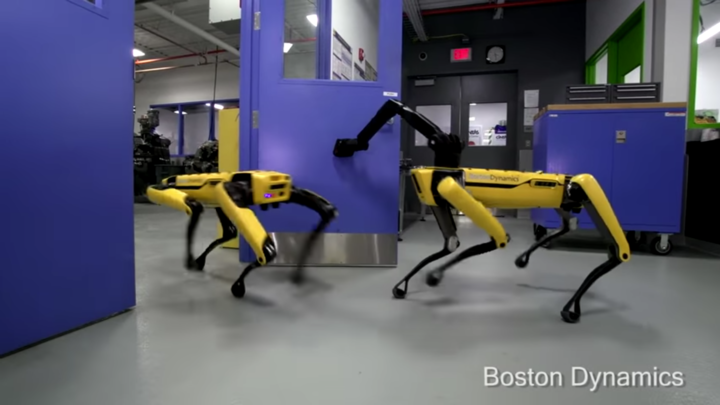
Straight out of a scene from the next "Terminator" installment, a recently released video features a four-legged robot skillfully opening a closed door and letting its less capable partner pass through.
Engineering and robotics firm Boston Dynamics titled its brief YouTube clip "Hey Buddy, Can You Give Me a Hand?" The footage has left many social media users utterly stunned.
In roughly 18 seconds, the robot extends its claw, twists the handle, holds the door for its fellow machine, and secures their entry into another room—all while exhibiting impressive agility, accuracy, and power.
While this door-opening trick might seem trivial to some, it arrives just three months after a Wall Street Journal article highlighted robots' struggles with hand-eye coordination in a government-sponsored competition.
That article bore the headline: "How to Survive a Robot Apocalypse: Just Close the Door."
The Boston Dynamics robot's ability to effortlessly overcome such obstacles has sparked widespread anxiety about humanity's future—or lack thereof.
Earlier videos have demonstrated that the Massachusetts-based company's expanding lineup of robots can walk and hop on two legs like humans, leap onto and off buildings, sprint at over 28 mph (faster than Olympic champion Usain Bolt), lift and transport heavy items, and execute backflips.
Since its establishment in 1992, Boston Dynamics has focused on creating machines that "both break boundaries and work in the real world," as stated on its website.
The company has secured funding from the U.S. Department of Defense, notably its Defense Advanced Research Projects Agency (DARPA), and the Army's Rapid Equipping Force. These funds contributed to developing the RHex—a compact six-legged robot capable of navigating rough terrain—and the SandFlea, a four-wheeled robot that can jump 33 feet into the air and land unharmed.
In 2013, Boston Dynamics was acquired by Google X, a subsidiary of Alphabet Inc. Although Google X reportedly intended to honor existing military contracts, it planned to reduce reliance on such funding and shift focus toward manufacturing and industrial automation, according to a New York Times article from that year.
By 2016, however, Boston Dynamics was back on the market. One reason cited was that Google X decided humanoid robotics did not align with its objectives and public image.
"There's excitement from the tech press, but we're also starting to see some negative threads about [Boston Dynamics’ work on robots] being terrifying, ready to take humans’ jobs," Courtney Hohne, a Google X spokesperson, said at the time.
In mid-2017, Japanese tech conglomerate SoftBank announced an agreement to acquire Boston Dynamics. But as The Financial Times reported last fall, the deal has been delayed by national security regulators.
SoftBank CEO Masayoshi Son remarked at the time of the agreed purchase that "there are many issues we still cannot solve by ourselves with human capabilities."
"Smart robotics are going to be a key driver of the next stage of the Information Revolution," he said in a statement praising Boston Dynamics and its team as "the clear technology leaders in advanced dynamic robots."
He added that SoftBank looked forward "to supporting them as they continue to advance the field of robotics and explore applications that can help make life easier, safer and more fulfilling."
Earlier in 2017, Son expressed his belief that machine intelligence would surpass human intelligence by 2047.
"It will be so much more capable than us — what will be our job? What will be our life? We have to ask philosophical questions. Is it good or bad?" he said at a conference in Barcelona. "I think this superintelligence is going to be our partner. If we misuse it, it’s a risk. If we use it in good spirits it will be our partner for a better life. So the future can be better predicted, people will live healthier, and so on."
Meanwhile, Boston Dynamics' stance on public fears of a robot uprising remains unclear. The company did not immediately respond to HuffPost's request for comment on the topic Tuesday.
One thing is certain: plenty of people are worried.
%22%20%2F%3E%0A%20%20%20%20%20%20%3Cstop%20offset%3D%22100%25%22%20stop-color%3D%22hsl(121%2038%25%2069%25)%22%20%2F%3E%0A%20%20%20%20%3C%2FlinearGradient%3E%0A%20%20%3C%2Fdefs%3E%0A%20%20%3Crect%20width%3D%221200%22%20height%3D%22750%22%20fill%3D%22url(%23bg)%22%20%2F%3E%0A%20%20%3Ctext%20x%3D%22600%22%20y%3D%22286.5%22%20text-anchor%3D%22middle%22%20fill%3D%22hsl(130%2052%25%2036%25)%22%20font-family%3D%22Inter%2C%20ui-sans-serif%2C%20system-ui%2C%20sans-serif%22%20font-size%3D%2224%22%20font-weight%3D%22700%22%20letter-spacing%3D%220.22em%22%3ETECH%3C%2Ftext%3E%0A%20%20%3Ctext%20text-anchor%3D%22middle%22%20fill%3D%22hsl(327%2038%25%2020%25)%22%20font-family%3D%22Georgia%2C%20'Times%20New%20Roman'%2C%20serif%22%20font-size%3D%2250%22%20font-weight%3D%22700%22%3E%3Ctspan%20x%3D%22600%22%20y%3D%22351.5%22%3EYouTube%26apos%3Bs%20So-Called%20%26apos%3BOpen%3C%2Ftspan%3E%3Ctspan%20x%3D%22600%22%20y%3D%22410.5%22%3ELetter%26apos%3B%20on%20Logan%20Paul%20Is%3C%2Ftspan%3E%3Ctspan%20x%3D%22600%22%20y%3D%22469.5%22%3EAnything%20But%20Transparent%3C%2Ftspan%3E%3C%2Ftext%3E%0A%3C%2Fsvg%3E)