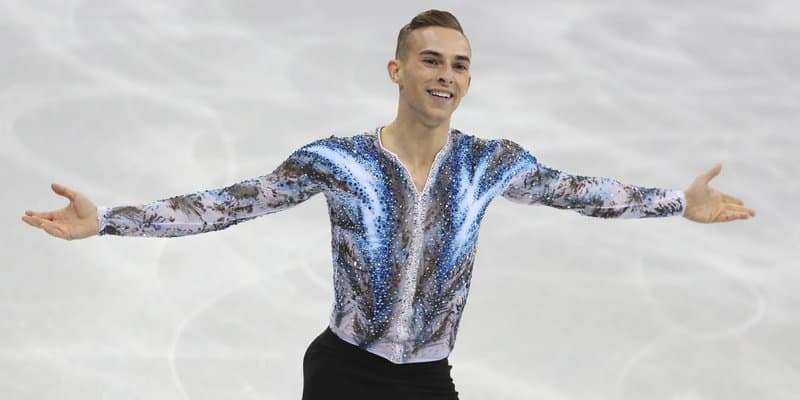
Before Adam Rippon secured a bronze medal for the United States earlier this week in the team figure skating event, he made headlines as the first openly gay athlete to qualify for a U.S. Winter Olympic squad.
Now, he is speaking candidly about his body image struggles for the same reason he came out as gay in 2015—to support others facing similar challenges.
In 2016, just prior to winning the U.S. figure skating championships, Rippon’s daily intake consisted of three slices of whole-grain bread with I Can’t Believe It’s Not Butter. His only other sustenance was coffee—three cups, each sweetened with six packets of Splenda.
“It makes me dizzy now to think about it,” Rippon told The New York Times.
Weighing 150 pounds today, Rippon is 10 pounds heavier than he was in 2016—and has garnered significant social media attention for his gluteal muscles, which he recently had to confirm are real.
There’s been a lot questions to whether I compete with butt pads on and I’d like to set the record straight and let it be known that no, it’s just my real butt. Thank you for your interest, comments, and concern. Love you. — Adam Rippon (@Adaripp) December 9, 2017
Back then, however, he aimed to mirror the physique of his younger teammates. “I looked around and saw my competitors…they’re a head shorter than me, they’re 10 years younger than me and they’re the size of one of my legs,” Rippon told The New York Times.
Rippon in 2016 Getty Images
According to the Times, when Rippon was just 10 years old, a former coach told his mother, Kelly Rippon, that he wouldn’t be able to execute more complex skating jumps due to his “heavy bottom,” and suggested he switch to speed skating. After noticing he was subsisting mostly on water-based vegetables as a teenager, his mom encouraged him to eat more protein. While he maintained a normal diet for several years, his move to California in 2012 to train under Rafael Arutyunyan changed that; his new coach urged him to adopt the three-slices-of-bread-a-day regimen.
Rippon is not the only male figure skater to face such weight-loss pressures. Brian Boitano, the 1988 Olympic champion, told The New York Times that judges would instruct him to shed pounds, even when his body fat was as low as four percent. Boitano noted that during his competitive years, he rarely consumed more than 1,800 calories per day, despite burning more than that in training.
Boitano remarked that his fellow skaters all lived with “an interesting relationship to food,” even after retiring from competition. Body-image issues have also been acknowledged in women’s figure skating; both Yulia Lipnitskaya of Russia and Gracie Gold of the United States recently withdrew from the sport due to eating disorders. However, male skaters are more inclined to remain silent about their body image struggles.
After breaking his foot during a warm-up in 2017, Rippon finally decided to work with Susie Parker-Simmons, a sports dietitian from the U.S. Olympic Committee. Parker-Simmons has helped the Olympic athlete address his issues so that he can view food as fuel rather than as an adversary.