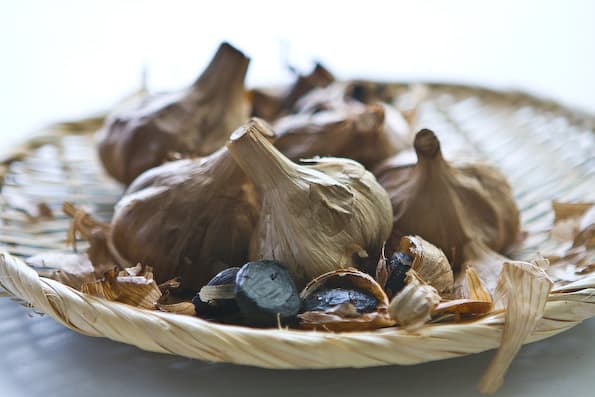
Even those who aren't vampires might raise an eyebrow at garlic that costs $60 or more for a pack of six bulbs. Yet in trendy kitchens, black garlic has become the latest culinary sensation. This fermented garlic gets its name from the dark color of its cloves after an aging process. Since appearing on the market about two years ago, it has gained a loyal following. Oil painter Choo Keng Kwang, 81, has been consuming roughly half a bulb of black garlic daily for several months. Mr. Choo, who has psoriasis—a skin condition causing itchy red patches or flaky scales—decided to try it after spotting a newspaper ad. He says in Mandarin: “The results were clear. After three to four days of eating black garlic, the red patches vanished. I had tried many doctor-prescribed creams before, and they didn’t work.” He spends about $6 per day on this black garlic regimen. The darkened cloves are available at select NTUC FairPrice and FairPrice Xtra, Giant hypermarkets, and Shop N Save supermarkets, with imports coming from China. Black garlic is made by fermenting whole fresh garlic bulbs at 65 to 80°C in a humidity-controlled room for nearly a month. After this, the cloves turn black, but the product isn't ready to eat yet because “the taste would be too bland,” says Ms. Low Gim Noi, 46, managing director of Defu Foodstuff, which sells black garlic. To achieve a sweet, prune-like flavor, the fermented garlic is left to oxidize in a clean room for 45 days. Black garlic can be eaten raw or cooked just like fresh garlic, she adds, recommending dishes such as chicken baked rice and bak kut teh. Singapore General Hospital dietitian Tan Ai Shan notes: “Unlike fresh garlic, black garlic is sweeter. The pungent smell and spiciness of fresh garlic are removed during fermentation.” She references 2007 experiments by Japanese researchers suggesting black garlic is more effective at reducing tumor size in lab mice, published in a Global Science Book journal on medicinal plant science. However, since most research on black garlic's health benefits has been on animals, Ms. Tan stresses that “there is still a lack of scientific evidence to support using black garlic for health purposes in humans.” Fermented garlic offers greater health advantages than the common variety, says nutritionist Velumani Deepapriya of the Singapore Nutrition and Dietetics Association. “Especially in improving blood circulation and boosting antioxidant levels in the body,” she adds. This is due to the production of water-soluble amino acid S-Allylcysteine, which has antioxidant properties, during fermentation. Antioxidants help protect cells from damage by unstable molecules called free radicals, which can lead to heart disease, blocked arteries, and cancer. Business consultant and part-time marathon runner Edward Goh, 50, started eating black garlic last June to lower his cholesterol, which was high at 250mg/dL. According to Singapore Heart Foundation guidelines, an average adult should keep total cholesterol below 200mg/dL. “I wasn’t taking medication because I don’t believe in putting chemicals in my body,” says Mr. Goh. “After eating two raw black garlic cloves daily for a few weeks, along with regular exercise, my cholesterol dropped below 200mg/dL.” Beyond health reasons, Mr. Goh, who spends $68 on a pack of six bulbs lasting about six weeks, enjoys the tangy sweetness of black garlic. He says: “It has a balsamic taste I really like. It’s very tasty.” Do you know the health benefits of black garlic? Its rising popularity could be great news for both our health and our diet. While not as well-known as its white counterpart, black garlic is making its mark with its unique flavor, vibrant color, and velvety soft texture. Plus, it may have twice the antioxidant level of white garlic. What is black garlic? Black garlic is made by fermenting whole garlic bulbs at high temperatures, producing the distinctive black cloves. This aging process involves no yeast or fungus. Garlic is rich in natural sugars and amino acids. During the month-long fermentation under strictly controlled heat and humidity, melanoidin forms—a dark substance often used in brewing to add flavor to ales and beers—which turns the garlic bulbs black. Developed in Korea, black garlic is simply aged and fermented garlic with no additives—no food coloring, no soy sauce (so it’s gluten-free!), and no preservatives—just pure garlic. The black color occurs naturally as sugars are drawn out during fermentation. Although garlic is the only ingredient, black garlic doesn’t taste like regular raw garlic. In fact, it’s unlike anything you’ve probably tried before. It’s full of umami and complex flavors that take your mouth on a gustatory adventure: a mild initial bite, followed by a burst of caramelized sweetness, and a rich savory finish. Black garlic isn’t just a culinary marvel; it’s also beneficial for your health! It’s no secret that garlic is good for you, with its abundance of Vitamin C and other antioxidants. The fermentation process doubles the antioxidant content found in raw garlic! If you dislike the pungent odor and spicy kick of raw garlic, or if you’re a garlic lover wanting to try it in a new way, black garlic is for you. Benefits of black garlic Fresh garlic is packed with high concentrations of sulfur-containing compounds—the source of its health benefits. One compound, S-allylcysteine, is a derivative of the amino acid cysteine, which may help lower cholesterol levels. “During fermentation, the compound allicin (which gives raw garlic its distinctive odor) is converted into S-allylcysteine,” explains registered nutritionist Robert Hobson. “This is water soluble, meaning it is absorbed more quickly and easily by the body.” The natural compound S-allylcysteine (SAC) aids in absorbing fat-soluble allicin, and it’s found in higher concentrations in black garlic than white. Rich in antioxidants Another benefit of black garlic is its antioxidant levels—it contains twice that of regular white garlic. “Antioxidants are essential for our immune system and for preventing and repairing damage to body cells,” says Robert. “Black garlic may also help lower cholesterol levels and offer some protection against infections as a natural antibiotic.” A study at The Pennsylvania State University showed that SAC, found in black garlic, inhibited cholesterol synthesis. “Black garlic can also positively impact blood pressure and circulation,” Robert adds. Adding black garlic to your diet Some describe black garlic as sweet meets savory. It has a tender, almost jelly-like texture and is often used in Asian cuisine. “Black garlic leaves no trace of smell (so it doesn’t cause bad breath); it can be eaten raw or as a snack, and it can be cooked like white garlic,” says Robert. It’s also available in supplement form. Take 3-5 cloves daily (before or after meals). High Blood Pressure: Garlic (Allium sativum) is one of the oldest medicinal plants. Evidence suggests adequate amounts of this “stinking rose” can effectively reduce blood pressure and possibly cholesterol levels. Headache Prevention: Similar to aspirin, garlic has a blood-thinning quality that prevents platelets from clumping together. Cold and Flu: Modern studies show garlic acts like a powerful antibiotic. Many people take garlic during cold and flu symptoms to help their bodies stay healthy. The key is to take garlic before a cold, as it helps combat the illness. Cardiovascular Benefits: Scientific studies indicate garlic helps prevent heart disease by reducing free radicals that cause cholesterol oxidation and cell membrane damage—the true causes of atherosclerosis and heart disease. Studies suggest garlic prevents plaque formation in arteries and may even reduce it. In Germany, garlic supplements are approved as drugs for treating atherosclerosis. Garlic also aids fat metabolism by increasing lipid breakdown and fat removal from the body. READ ALSO Your Skin Will Say Thank You: 5 reasons to buy grape seed oil READ MORE 12 Anti-Aging Herbs and Nutrients First appeared on worldtruth.tv
Dark Fermented Garlic: A Skin-Soothing, Circulation-Boosting Superfood Worth Trying
Discover how aged black garlic may help with flaky skin and blood circulation. Learn about its unique taste, health benefits, and how to add it to your diet.
Related Articles

8 Key Factors Driving Premature Aging in Today's Generation
Explore the main external and internal causes accelerating aging among 18–40 year olds, from genetics to lifestyle choices, and learn how to slow the process.

Can Humans Achieve Immortality by 2050? AI and Genetics May Hold the Key
A top futurologist suggests that those born after 1970 could potentially live forever, thanks to breakthroughs in AI and genetic engineering by 2050.

Coronavirus vs. Corona Beer: Why Millions Mistake One for the Other
Google Trends data reveals that millions of users have searched for links between the novel coronavirus (2019-nCoV) and Corona beer, despite the two sharing only a name. Discover the surprising search trends.
Rejuvenate Naturally: 12 Herbs and Nutrients to Combat Aging
Discover natural herbs and nutrients that support youthful vitality without invasive procedures. Explore 12 anti-aging allies backed by research.

Frozen Yoga Poses at -41°C on Russia's Legendary Baikal-Amur Mainline
Tynda, the capital of the Baikal-Amur Mainline (BAM), Russia's alternative trans-Siberian railway, becomes a freezing yoga studio for two women practicing asanas at temperatures as low as -41°C.

Staying Busy with Work Preserves Mental Wellness During Isolation, Research Finds
A study by Chinese researchers indicates that individuals cope more effectively with isolation when they remain engaged in work activities.