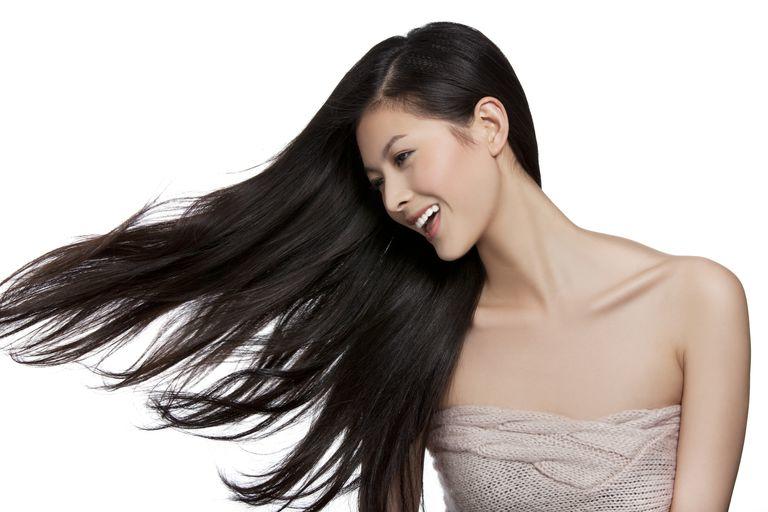
Do you battle frizzy, hard-to-manage curly hair every day? Spending hours blow-drying and taming your mane? We understand the struggle. Japanese hair products have long led the global haircare industry. That's why we've compiled this complete guide to Japanese hair straightening treatments—designed to make every day a great hair day.
Japanese hair straightening, also called thermal reconditioning, is a permanent straightening method that originated in Japan during the 1990s. It transforms wavy, coarse, or curly hair into perfectly straight strands by using chemicals that break the protein bonds responsible for your hair's natural shape. The process then employs specialized flat irons heated to exact temperatures to complete the transformation. This technique first gained popularity in the United States in New York City around the early 2000s and is now offered in salons nationwide.
This permanent straightening procedure offers numerous advantages. The most obvious is a smooth, frizz-free appearance. But beyond looks, the biggest benefit is the time saved daily—no more wrestling with a blow dryer and brush to tame waves or curls. Hair treated with thermal reconditioning dries much faster and requires minimal styling after washing, giving you a polished look with little effort. You'll also avoid battling frizz caused by humidity or physical activity.
However, if an inexperienced person performs this treatment, the results can be disastrous.
It can fry your hair, and some women have experienced significant hair loss. This is a major reason the process has sparked controversy.
If your hair has been colored or received other chemical treatments, you risk further damage. An experienced stylist should assess whether your hair is a suitable candidate. Be honest about any prior processing—speak up.
To avoid problems, choosing a stylist experienced in Japanese hair straightening is crucial. Ask how many treatments they've performed and how long they've been doing them.
You'll also need to forget about perms or any chemical processes that restore natural waves. Additional chemicals only increase damage, so you must commit to letting the straight hair grow out.
Hair texture significantly affects success, especially for African American women. Depending on your hair type, chemical relaxers might be a better option.
Before booking an appointment, think carefully about whether this is right for you. It can create a beautiful look, but you must fully understand the risks.
Japanese hair straightening relies on a special solution applied to the hair. This solution breaks down the bonds that give hair its shape, allowing it to become pin-straight with help from a flat iron.
The hair is saturated with the solution, rinsed, blow-dried, and then flat-ironed with a ceramic iron in tiny 1/8-inch sections. A neutralizer is applied afterward to lock the style in place.
The entire process is labor-intensive and time-consuming. Depending on your hair's length and thickness, expect to spend several hours in the salon.
The cost of thermal reconditioning varies based on the procedure's duration, which depends on hair length, volume, and previous processing. A typical treatment ranges from $300 to $1,000. You might find cheaper options, but be wary of salons offering significantly lower prices. Horrifying stories of burnt hair or even hair loss often stem from cheap work by inexperienced stylists.
Touch-ups are usually needed every 6 to 9 months, depending on how much curl appears in new growth. These sessions take less time and cost much less than the initial treatment. However, don't skimp on a cheap stylist for touch-ups—consistently flattening new growth to match the old is just as challenging as the original procedure.
This straightening treatment lasts about six months—twice as long as the Brazilian straightening method.
Although both treatments are called "permanent straightening," they're like a perm for curly hair—permanent only in the sense that it's irreversible and you must wait for it to grow out.
This is a downside because it doesn't always look great when the top of your hair has waves while the ends remain pin-straight.
In that way, it's the opposite of a perm, which many women can manage as their hair grows after deciding they no longer want curls. With straightening, you either need patience and creative styling, get a retreatment, or go for a drastic haircut.
After treatment, you must be very careful with your new pin-straight hair. You cannot wash it or pull it into a ponytail for at least three days while it sets.
As mentioned, it's critical to protect your hair from water and any bending during the first two to three days following the procedure. Even though the stylist is done, the chemicals are still working. The neutralizer needs to absorb oxygen from the air as your hair settles into its new shape.
Special shampoos and conditioners help maintain the health and shine of your new style. A thermal heat protector is recommended to avoid damage from flat ironing or blow-drying.
You can color your hair after a permanent straightening, but wait at least two weeks and have it done by a professional. A protein treatment beforehand helps ensure great coloring results. As with any delicate process, things can go wrong—sometimes very wrong, especially if you cut corners on your stylist's experience.
Problems from a poorly done straightening procedure can include unnatural "bends" in the hair, tight scalp, breakage, and hair loss. Always speak to the salon owner about any issues; they should at least refund your money, even if they don't actively fix the problem. Japanese hair straightening isn't for everyone. But if you're among the many women seeking a long-term straightening solution, it could be the perfect option for looking great while saving time and money in the long run.