As I grow older, I keep realizing that being an “adult” doesn’t automatically grant you maturity, confidence, or know-how. Reaching a certain age doesn’t guarantee everything falls into place the way it seemed to for every grown-up you admired as a child. Our ideas about coming of age and becoming an adult are shaped by external models—mashups of societal expectations about what you should have accomplished by now: the suburban house, the spouse, the 2.5 kids, or the corporate job with shoulder pads and sophisticated cocktails after hours. These goalposts keep shifting, becoming less attainable for each new generation. Maybe you don’t own a home; maybe you’re renting an apartment and sharing it with a roommate long after college. Maybe you lack a full-time job and instead juggle part-time work with pitches sent from coffee shops.
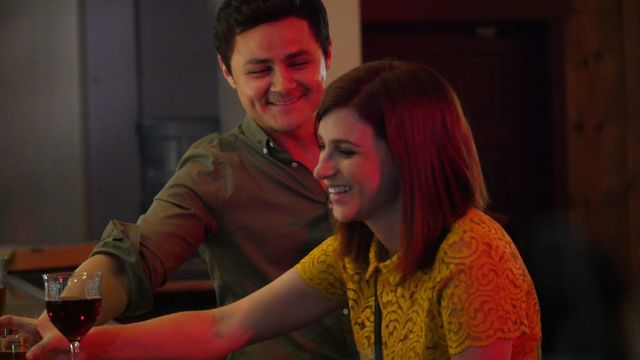
Although Brand New Old Love is marketed as a romantic comedy about two friends (Aya Cash from You’re the Worst and Arturo Castro from Broad City) who vow to marry each other by age thirty—a popular nineties trope—it also serves as an honest, unglamorous look at what adulthood meant in the 2010s. Written and directed by Cat Rhinehart (My Super-Overactive Imagination, Recycled Babies), the film adopts the comedic style of shows like Transparent, Barry, and Catastrophe: not laugh-out-loud funny, but handled with a light touch. Without the tropey premise, sunny Southern California palette, upbeat pop soundtrack, and kitschy cassette-tape framing device, Brand New Old Love would play as a straight drama about the weight of adult expectations—whether they come from society, your surroundings, or yourself. Ultimately, even if your friend or sibling seems to have their life together, they absolutely do not; we’re all just pretending we know what we’re doing.
Hannah (Cash) is freshly divorced, flush with cash, and completely out of fucks to give. Charlie (Castro) is a sentimental fitness instructor whose acting career is going nowhere. When they bump into each other one gloomy night at a bar in their hometown of Modesto, California, they decide that since they don’t have the careers or lives they truly want, they might as well fulfill their old promise to marry. Charlie (whom Hannah affectionately calls “Chuckie”) finally escapes the friendzone and lands his dream girl, while Hannah gets to feel adored and worshipped, hoping Charlie’s dormant feelings for her high-school self will transfer to the person she’s become.
Once they settle into their new life as a couple in LA, cracks start appearing. Some come from external forces, like Charlie’s eccentric roommate Bruce (Josh Brener, Silicon Valley), who keeps bursting into their bedroom to use the en-suite bathroom (the only one in the one-bedroom apartment) with an endless parade of attractive women. But almost every misunderstanding in their fledgling marriage stems from their conscious and unconscious attempts to create the kind of relationship they think they should have. Lacking a closer, more immediate example, they base their marriage on archetypes and beats from pop culture, hoping that mimicking happy marriages will make their own happy. On their first night in LA, Charlie is surprised and disappointed that Hannah wears comfortable sweats and a T-shirt to sleep on their wedding night—he was raised on images of brides in negligees (as were we all). Soon, the apartment fills with both his-and-hers junk as they cram their two beds together in his room, a perfect example of their inability to compromise like real adults.
After establishing the quirks and corners of Hannah and Charlie’s marriage, Brand New Old Love loses some narrative momentum. Yet attention to detail and gentle foreshadowing—like Hannah’s tomato allergy or Bruce’s grandfather’s own marriage—tie everything together. Aya Cash tones down the bluntness of her iconic role on You’re the Worst to slip into what I call an Aniston-ian mode. Hannah always forces a smile and laugh; even when uncomfortable, she radiates that leading-lady glow, the way of a girl who’s always been told she’s pretty and soaks up praise like sunlight.
But Modesto Pretty is apparently different from Los Angeles Pretty, as Hannah soon learns. Charlie buys her yoga pants to replace her sweatpants, setting off alarm bells. Hannah learns from a group of attractive, Goop-y brunching women (I really don’t know how else to describe them) that she’s developing “elevens” in her brow line, and promptly freezes her face with Botox. Arturo Castro’s Charlie gets slightly more development—we spend much more time in his circle than in hers—and his transformation from giddy excitement to disillusionment is compelling. Bruce, when first introduced, risks coming across as overly broad, like something from an SNL sketch or an Adam Sandler movie. Yet Brener plays Bruce’s oddities as layers on top of genuine melancholy: despite disavowing marriage, he envies his grandfather, who loved his wife until the day she died, and he fears that Charlie will stop being his best friend now that he’s married.
What Brand New Old Love does best is show that even with evidence to the contrary, none of the seemingly more “adult” characters know what they’re doing. Charlie’s brother (David DeSantos, The Rookie), a proud married father of a newborn, crashes on the apartment couch and finds himself smoking weed with the baby in the room. There are moments where you can fake it till you make it, and moments where people project their own images of adulthood onto you, meaning you pass a test you didn’t even know you were taking. In one scene, Hannah and Charlie try to relive their high-school glory days by going to a punk concert, only to feel wildly out of place among the punks by the stage door, who ask about their kids. In the end, a juvenile act of trespassing provides the missing spark in their marriage, proving… something? Proving, I suppose, that adulthood isn’t one-size-fits-all. Maybe the secret of being an adult is simply that you are one when you can look in the mirror and tell yourself so, without caveats, without that self-conscious, sarcastic groan of “help, I hate adulting,” regardless of the milestones you’ve hit or missed along the way.
Top photo: Brand New Old Love
Deborah Krieger is a freelance arts and culture writer and an aspiring art/media historian and curator. You can find her at www.i-on-the-arts.com and on Instagram @debonthearts.
15 Indicators You’ve Already Encountered Your Soulmate