Nintendo’s Switch has been a massive success, allowing gamers to play on the go or at home on their TV. Next week sees the launch of its first major accessory: Nintendo Labo, a set of cardboard kits that pair with the console’s components to create various toys—including a piano. But does Labo hold any promise for seasoned music-makers? Scott Wilson gets hands-on with Nintendo’s latest creation.
Nintendo isn’t the first name that comes to mind for music technology, yet the Japanese gaming giant has long attracted curious, musically inclined players. From the music generator in the 1992 SNES title Mario Paint, to the Korg apps on the DS handheld, to DIY hackers turning Game Boys into chiptune machines, Nintendo has facilitated music-making for decades. Even Kraftwerk used a modified Nintendo Power Glove to control synthesizers in the early ’90s.
Despite this history, Nintendo never developed its own music-making peripherals (unless you count the DK Bongos from 2005’s Donkey Konga). That changes next week with Nintendo Labo, the company’s new Switch add-on. It’s part video game, part construction toy, and part maker platform. You can buy one of two kits (the Variety Kit and Robot Kit), each containing a Switch cartridge and several sheets of pre-cut, push-out cardboard shapes. These mini flat-packs assemble into various “Toy-Cons” that interact with the console’s screen and Joy-Con controllers—like a radio-controlled car, motorbike, fishing rod, house, and piano.
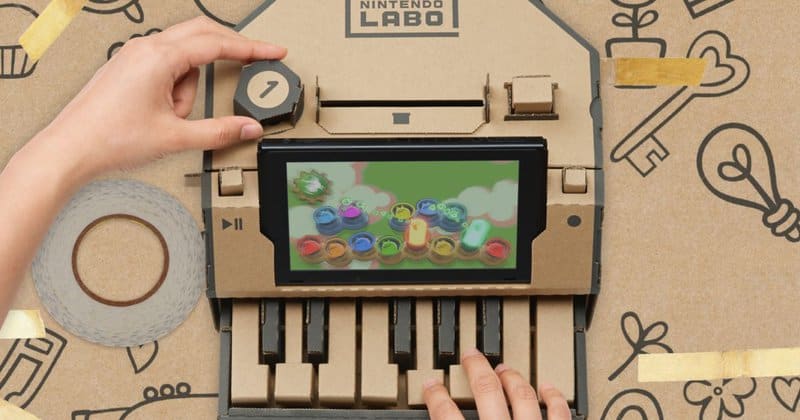
I got a sneak peek at Labo last week and tried all of these. They were incredibly fun: I used felt and pipe cleaners to turn my RC car into a Super Mario Bros Goomba and battled it sumo-style; raced a motorbike around a track in a game as enjoyable as Mario Kart; fed a strange creature inside a house with jellybeans; caught fish; and wore a cardboard robot costume to stomp, smash, and fly through a destructible city. But what I most wanted to test was the Labo Piano, a musical instrument with cardboard keys, a pitch bend lever, and swappable volume and effects knobs.
You build the piano from its basic cardboard parts using a LEGO-like instruction manual on the Switch screen—a process Nintendo says can take up to a few hours depending on age and skill. Once assembled, the Switch screen slots into the front, the right Joy-Con (with IR camera) fits inside, and the left Joy-Con sits on top. The Labo software offers two modes: a basic instrument and a GarageBand-style studio, presented in Nintendo’s cute aesthetic. Press a key, and the IR camera detects which one was triggered, playing the corresponding note through the Switch’s built-in speaker. It’s remarkably simple, yet the fact that you’re playing a working cardboard piano is still astonishing.
You can also build four interchangeable knobs that fit into a top hole, each controlling a different parameter: volume, reverb, envelope, and one that vibrates the second Joy-Con for an acoustic effect as it rattles against the cardboard. Several patches are available, each transformable from a short, sharp struck note to a sustained pad sound. The sounds are basic—a piano, a cat, a very odd singing man—but for anyone new to synthesis, the Labo piano provides a simple yet effective primer on sound design fundamentals.
The piano’s most innovative feature is scanning custom waveforms. Cut a waveform shape into a piece of card, slot it into a top hole, and it modifies the sound accordingly. You can use a conventional sawtooth wave, but it’s more fun to see what sound Mario’s face produces. The input slot also lets you sequence drum loops: the Variety Kit includes a card with four rows of pre-cut holes, each row corresponding to a different drum track and each hole a point on the loop. By pushing out the card, you can “sequence” your own drum loops. It’s a bit laborious to build a rhythm this way, but like the piano’s other functions, it offers an easily digestible introduction to how a real drum machine works.
These real-world applications make the Labo piano more than a toy—using it is also a learning experience. The GarageBand-style Studio lets you go deeper: you can wield a baton to change tempo, adjust note octaves, and record simple tracks. Press the record button on the top right, and the screen switches to a track view that records pressed notes for later playback. It’s very basic—you won’t see producers using it like early grime and dubstep producers used PlayStation’s Music 2000—but Nintendo embedding a simple DAW inside a cardboard toy is significant. For many kids, the Labo Piano will be their first encounter with a musical instrument.
So does Labo have potential for adults or the DIY community? As far as the Piano goes, probably not. You can’t circuit-bend it (unless you want to ruin your Switch), and it offers limited sounds. Even for mobile music-making, it’s nowhere near as powerful as Groovebox, Auxy, ROLI’s Noise, or other all-in-one music studio apps on iOS. But delve deeper into the Labo software, and you’ll find a component that could be exciting: Toy-Con Garage.
Nintendo Labo’s slogan is “Make, Play, Discover”—first you build your Toy-Con, then play with it, then discover how it works. For the Piano, that means learning that the IR camera detects key presses, but there’s a whole ecosystem enabling the Switch to respond to Toy-Cons and trigger actions. Nintendo doesn’t stop at discovery; it encourages using this knowledge to create your own systems. This happens inside Toy-Con Garage, a section where you write your own code to make Labo do what you want. It reminded me of Max or Reaktor’s visual environment, but much simpler: you connect input and output blocks from left to right, and the Switch performs actions based on stimuli.
For example, you can select “If a Button Is Pressed > Joy-Con (L)” as input and “Make Sound > A” as output to play an A note. You can also map actions like “If Shaken” or “If The Joy-Con Is Face Up.” It’s easy to grasp the basics and create a simple line of code for playing melodies via the Joy-Cons, and this extends to the Switch’s screen. In the example I saw, you can turn the Switch into a stringed instrument by coding the touchscreen as a simple keyboard and wrapping rubber bands around it to simulate a guitar. Again, it’s not something you’d use for recorded music, but the process of coding an instrument is a simplified version of making synths in Reaktor 6 or Max for Live.
Once Labo hits shelves, we’ll undoubtedly see people doing things Nintendo never imagined. Musical instruments will likely be part of that, but for now those instruments are limited by the sounds they can produce. Labo is, after all, a toy, and while Nintendo could add a deeper synthesis engine in a future update, that would go against its inclusive, pick-up-and-play ethos. However, we might see people using Toy-Cons to create mechanical contraptions that trigger existing instruments, like Dadamachines’ Automat Toolkit. The most significant impact will be introducing music to people who’ve never played an instrument and inspiring those who’ve never coded to create their own instruments. Companies like Native Instruments and Ableton should watch this generation of Labo users—they could be the musical innovators of tomorrow.
Scott Wilson is FACT’s tech editor and a lifelong Nintendo fan. Find him on Twitter