Architect David Dworkind has created and assembled a range of ash wood tables, benches, and stools to fit as many guests as possible inside this slender Montreal cafe, which offers Lebanese street food and baked treats.
The informal Lebanese dining spot Jouney was conceived by Patrick Abdelahad, who chose the name after his birthplace Jounieh – a coastal town situated north of Beirut.
Abdelahad enlisted David Dworkind to reimagine the 1,750-square-foot (162-square-metre) Jouney cafe located on Rue Bélangerin in central Montreal.
The local architect focused on optimizing the venue’s unusual elongated and narrow layout, while also promoting different dining preferences.
“The long narrow restaurant can seat 40 in an array of different seating options,” said Dworkind.
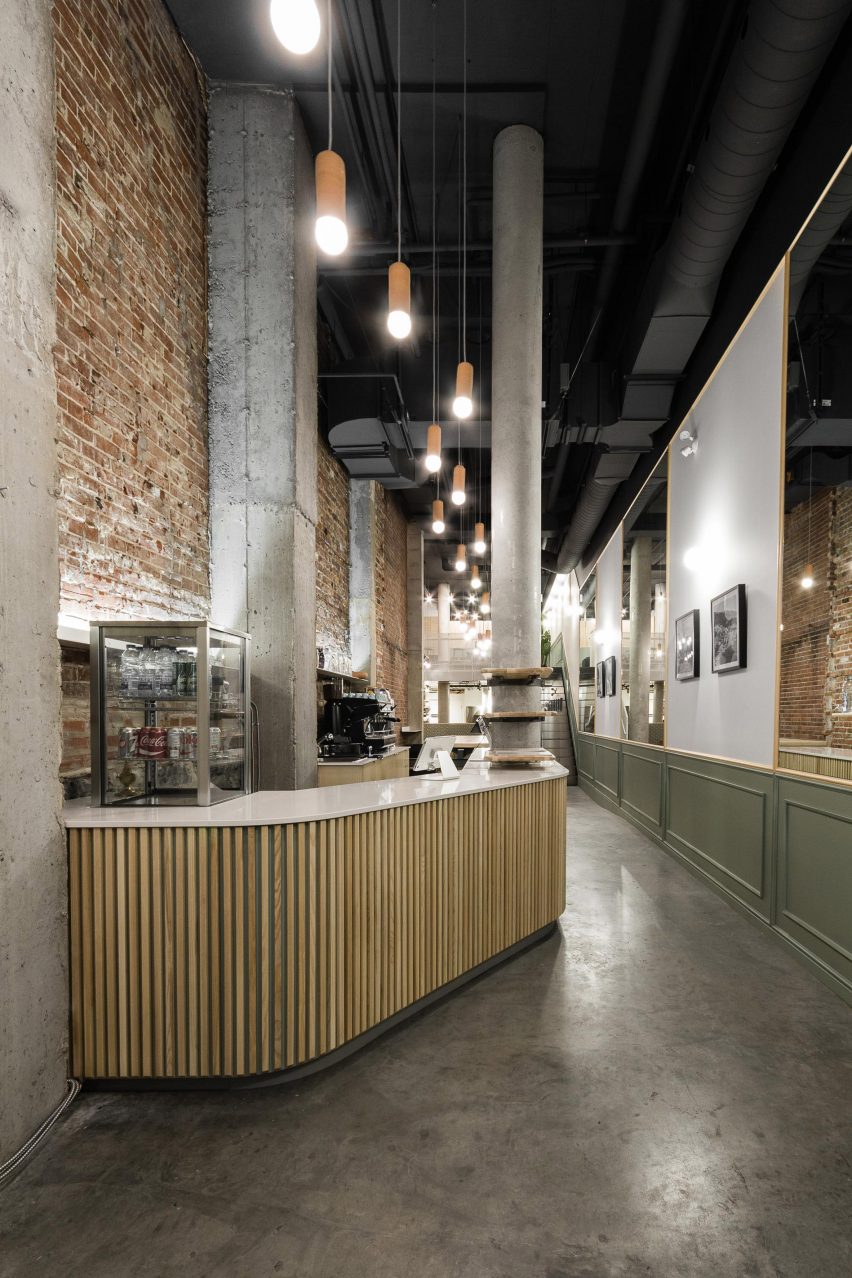
Patrons, who place orders at a curved counter fronted by wooden slats positioned in the middle, can eat alone side by side on the bench at the cafe’s front, where round tabletops extend from levers mounted on the wall.
A line of rectangular tables is set against the opposite wall to create banquette seating, while a larger table at the back encourages group dining. The wooden tabletop is supported by a black metal I-beam structure that bridges a floor slope, and its matching stools are likewise anchored into the ground.
Bar stools are also positioned along the balcony on the mezzanine level, offering views across the cafe. A lounge-style setup, including a sofa, also occupies this upper floor.
Dworkind’s renovation reveals the existing industrial elements, such as the nearly five-meter-high brick walls on one side—featuring patched areas—and the aged concrete columns and flooring. The ceiling fixtures are also exposed but painted black.
The architect selected neutral shades of green, black, and white along with a simple material palette to harmonize with the concrete and brickwork, similar to Appareil Architecture’s design of another Montreal restaurant.
Inside Jouney, decorative siding along the base of the wall opposite the brickwork is painted green. The white-painted upper section is outfitted with large mirrors that make the space feel larger.
Ash wood tables and chairs with rounded edges, as well as patterned green terracotta tiles “inspired by the tiled roofscapes of Lebanon” that front the kitchen at the back of the cafe, are among the new additions.
Other terracotta elements include handmade tubular pendant lights hanging at varying lengths down the cafe, and plant pots displayed on shelves alongside photographs and ornaments.
The monochrome perforated steel staircase leading to the mezzanine features a white balustrade and folded black steps.
Appareil Architecture converts old Montreal factory into modern restaurant
Photography is by David Dworkind.