Back in November, as I noted earlier this week, Hamburg's Zoological Museum unveiled a richly perceptive and enthralling exhibition called Verschwindende Vermächtnisse: Die Welt als Wald / Disappearing Legacies: The World as a Forest. The project traces in the wake of Alfred Russel Wallace, the British naturalist who, more than 150 years ago, independently co-developed the theory of natural selection while conducting fieldwork in South America and Southeast Asia. A century and a half hardly qualifies as a long stretch. Yet should Wallace revisit those equatorial ecosystems today, he would almost certainly find them unrecognizable. Vast stretches of rainforest have vanished at breakneck speed, cleared by aggressive timber extraction, agricultural expansion, and urban sprawl. Countless species have been pushed into oblivion along the way. Could natural selection still emerge as a theory from such ravaged landscapes?
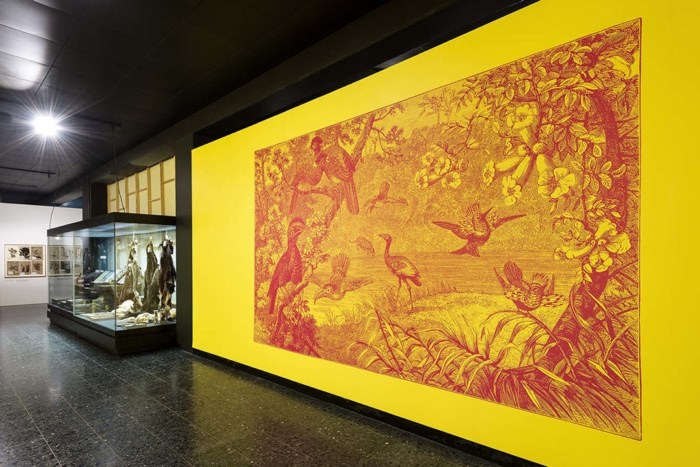
Exhibition view (entry lithograph of Amazonia.) Photo: ReassemblingNature.org, Michael Pfisterer
Armin Linke, Orangutan in the Tanjung Puting National Park, Kumai, Kalimantan Tengah (Borneo) Indonesia, 2017. Photo: © Armin Linke
Disappearing Legacies: The World as a Forest assembles contemporary artworks alongside zoological and botanical specimens to scrutinize the transformations sweeping across the tropical regions Wallace once explored, while illuminating the ecological dilemmas confronting today's wildlife and plant life in the Amazon, Indonesia, Malaysia, and Singapore.
The presentation also challenges our conventional understanding of nature: how might such a concept be represented and sustained amid extinction, deforestation, and climate upheaval?
Rather than being confined to a pristine white-cube gallery, the artworks inhabit the museum's main exhibition halls. This curatorial strategy means that families arriving to admire stuffed bears and tropical blooms suddenly find themselves face to face with provocative queries and objects they would rarely encounter elsewhere in such intimate depth. Some may view it as an unconventional choice, but I found it absolutely inspired, for two reasons: first, I champion any effort to widen the reach of contemporary art; and second, by placing the works amid a classic Natural History Museum, the curators urge us to question what role such an establishment ought to assume in the era of the Anthropocene and the Sixth Mass Extinction. Does our grasp of biology and evolution require a thorough overhaul?
Below is a brief and highly incomplete stroll through the exhibition:
Shannon Lee Castleman, Tree Wounds, Muna Island, Southeast Sulawesi, 2010-2011
Shannon Lee Castleman, Tree Wounds, Muna Island, Southeast Sulawesi, 2010-2011
Shannon Lee Castleman, Tree Wounds, Muna Island, Southeast Sulawesi, 2010-2011. Verschwindende Vermächtnisse: Die Welt als Wald. Photo: UHH/CeNak, Reiss
Shannon Lee Castleman's Tree Wounds series struck a deep emotional chord. She captured them during a research journey to Muna Island in Indonesia.
While exploring the locale, the photographer observed massive injuries marring many of the mature teak specimens within the protected woodland. These groves are aged teak plantations that have been reclassified as "conservation" forest—not because of biodiversity, which was obliterated during 19th- and 20th-century timber cultivation, but because former plantations help regulate the island's water table. Castleman learned that since chopping teak within these zones is prohibited, destitute villagers passing towering trees sometimes inflict successive axe cuts one after another… until eventually the tree topples or perishes and no party bears responsibility.
The imagery of these battered trees narrates, on an intimate scale, the broader catastrophe of deforestation and illicit logging unfolding across the planet.
Julian Oliver & Crystelle Vũ, Extinction Gong, 2017
Julian Oliver & Crystelle Vũ, Extinction Gong (details at the back of the gong), 2017
Julian Oliver and Crystelle Vũ's Extinction Gong functions as a ritualistic automaton commemorating the Sixth Mass Extinction.
The Chinese 'Chao Gong' reverberates in time with the disappearance of species, which biologist E.O. Wilson pegged at roughly 27,000 losses annually, equivalent to one every 19 minutes. Although this figure errs on the cautious side, it still dwarfs the typical background rate (the natural extinction pace unaffected by human activity) for plants, animals, and insects.
Should scientists officially declare another species extinct while the Extinction Gong operates, it will be notified through a 3G connection and execute a distinct ritual: four swift strikes accompanied by a text-to-speech recitation of the vanished species' Latin name, reverberating across the gong's surface.
The obverse of the Chinese 'Chao Gong' bears the Extinction Symbol, the recognized emblem of the Sixth Mass Extinction. The reverse, by contrast, lays bare the mechanical workings of the piece.
I was profoundly stirred by this creation. It grants stature and honor to insects, plants, and creatures that vanish in silence while most of us remain oblivious and uncaring toward biodiversity's decline.
Robert Zhao Renhui / The Institute of Critical Zoologists, Useful Nature, Useless Nature, 2017
Robert Zhao Renhui / The Institute of Critical Zoologists, Useful Nature, Useless Nature, 2017
Robert Zhao Renhui / The Institute of Critical Zoologists, Useful Nature, Useless Nature, 2017
In recent years, Robert Zhao Renhui has been cataloging the myriad manners in which humanity reshapes other forms of life. Both directly and indirectly. His photographic compositions depict animals, insects, and plants compelled to adapt in response to mounting pressures from a swiftly transforming planet—or as a direct consequence of human manipulation, whether for scientific inquiry or aesthetic indulgence.
For the Hamburg exhibition, the photographer concentrated his inquiry on insects. Within the span of a single day, Zhao collected insect remains from windows, traps, household nooks, and other tight spots in his Singapore studio. The specimens expose the astonishing diversity of insect life coexisting alongside humans while escaping widespread notice.
The bodies are arranged in meticulous rows inside one display case. An adjacent vitrine showcases an assortment of devices and chemicals deployed to repel and exterminate insects.
One query Zhao poses concerns our inconsistent affection for nature, particularly insects: what motivates us to label certain species as valuable commodities while branding others as nuisances or vermin? What authority do we possess to revere some, grudgingly accept others, and annihilate a third category of insects?
The piece is tragically reinforced by findings from recent investigations that documented a steep collapse in insect populations across Germany: researchers calculated that the nation now harbors merely 76 percent of the flying insects it did three decades ago.
Lower jaw of the critically endangered Sumatran rhinoceros in the CT scanner of YXLON. Photo: Reassembling the Natural / Etienne Turpin, 2017
Skull of the critically endangered Sumatran rhinoceros in the CT scanner of YXLON. Photo: Reassembling the Natural / Etienne Turpin, 2017
Since rhino horns command steep prices on illegal markets, even the skulls of creatures long deceased have been pilfered from zoological collections. To mark Disappearing Legacies: The World as Forest, CT-scanner manufacturer Xylon International generated a high-definition scan of a Sumatran rhinoceros skull drawn from the Mammal Collection of the CeNak. Notably, the specimen's horn had already been severed prior to its acquisition for the collections.
Armin Linke and Giulia Bruno, Riau, (Sumatra) Indonesia. Photo: Reassembling the Natural/Anna-Sophie Springer, 2017
Drone Akademi Indonesia, Indonesian Province of Riau, Sumatra. Photo: Reassembling the Natural/Etienne Turpin, 2017
In 2014, activist geographer Radjawali Irendra established Akademi Drone Indonesia (ADI), a body devoted to research, education, and policy relating to unmanned vehicles for terrestrial and aquatic study, alongside advocacy focused on environmental concerns.
Indigenous groups and economically disadvantaged populations facing threats to their land tenure employ ADI's drones to assemble precise spatial information, generate their own overhead images, and contest prevailing official accounts.
Paulo Tavares, Trees, Vines, Palms and Other Architectural Monuments, 2017. Satellite and ground identification of the ancient village of Bö'u, the old geopolitical center of the Xavante territory of Marãiwatsédé, which is still outside their demarcated land. Credit: Bö'u Association/autonoma
Paulo Tavares, Trees, Vines, Palms and Other Architectural Monuments, 2017. Policarpo Tserenhorã and Domingos Hö'awari conduct botanic inventory research in the cemetery site of the ancient settlement of Tsinõ. Credit: Bö'u Association/autonoma
Between the early 1950s and the close of the 1960s, the A'uwe-Xavante, an indigenous community of the Brazilian Amazon, endured savage land dispossession and forced expulsions designed to clear terrain for enormous cattle operations and soybean plantations. The drive formed part of a territorial colonization plan that Brazil's military characterized as "occupying demographic voids."
In 1966, the A'uwe of Marãiwatséde were evicted from their hereditary territory in an operation directed by the Brazilian Air Force. In 1974, the State Indigenous Agency (FUNAI) issued a declaration certifying that this territory was no longer indigenous land.
Working alongside the Bö'u Xavante Association of Marãiwatséde, a squad headed by architect Paulo Tavares carried out a forensic investigation of the locations, charting and surveying their ancestral settlements and burial grounds to furnish proof of their historical stewardship of this territory.
The investigated sites share striking characteristics in that a swathe of vegetation had sprouted precisely in the arc-shaped outline of the ancient village. Composed of medium and large trees, palms, and assorted other plants and vines, these botanical formations incorporate species traditionally linked to Xavante habitation and land stewardship practices. The botanical formations function as analogues to architectural ruins. Among the questions posed by this research into the interplay between wildness and domestication of forests are:
Ursula Biemann and Paulo Tavares, Forest Law, 2014. Installation view
Revital Cohen and Tuur Van Balen, Paradise (multiply), 2017, cyanotype on paper. Photo: Michael Pfisterer
I want to leave you with additional photographs from the exhibition and a passage from Alfred Russel Wallace that reads as though penned yesterday rather than in 1910:
Yet during the past century, which has seen those great advances in the knowledge of Nature of which we are so proud, there has been no corresponding development of a love or reverence for her works; so that never before has there been such widespread ravage of the earth's surface by destruction of native vegetation and with it of much animal life, and such wholesale defacement of the earth by mineral workings and by pouring into our streams and rivers the refuse of manufactories and of cities; and this has been done by all the greatest nations claiming the first place for civilisation and religion! And what is worse, the greater part of this waste and devastation has been and is being carried on, not for any good or worthy purpose, but in the interest of personal greed and avarice; so that in every case, while wealth has increased in the hands of the few, millions are still living without the bare necessaries for a healthy or a decent life, thousands dying yearly of actual starvation, and other thousands being slowly or suddenly destroyed by hideous diseases or accidents, directly caused in this cruel race for wealth, and in almost every case easily preventable. Yet they are not prevented, solely because to do so would somewhat diminish the profits of the capitalists and legislators who are directly responsible for this almost world-wide defacement and destruction, and virtual massacre of the ignorant and defenceless workers.
Alfred Russel Wallace, 1910
"Natives of Aru shooting the great bird of paradise", in Wallace, The Malay Archipelago, 1869
Revital Cohen and Tuur Van Balen, Savane Du Sud Dessus, 2016
Revital Cohen & Tuur van Balen, Raggiana, Emperor, and Red (2017), neon sculptures made from rare neon, mammoth ivory, copper, and color. Photo: Michael Pfisterer
Beetle drawings in Alfred Russel Wallace's Natural History Notebook, 1854. Photo: Reassembling the Natural/Etienne Turpin, 2014. Courtesy Linnean Society London
Palm oil plantation in the Indonesian province of Riau, Sumatra. Photo: Reassembling the Natural/Etienne Turpin, 2016.
Mark Dion, Monument for the Anthropocene, 2014. Courtesy the artist and Galerie Nagel Draxler, Berlin/Köln
Exhibition view (Wallace panel / Mark Dion rhino replica.) Photo: ReassemblingNature.org, Michael Pfisterer
Exhibition view. Photo: ReassemblingNature.org, Michael Pfisterer
Exhibition view. Photo: ReassemblingNature.org, Michael Pfisterer
Verschwindende Vermächtnisse: Die Welt als Wald. Photo: UHH/CeNak, Reiss
Barbara Marcel, The Open Forest, 2017. Still from the Videoessay
Barbara Marcel, The Open Forest, 2017. Still from the video essay
Armin Linke, Palm oil plantation, Kecematan Bataian Kabupaten Rokan Hilir (Sumatra) Indonesia, 2017. Photo: © Armin Linke
Armin Linke, Fighting fire in the peatland, Kecematan Bataian Kabupaten Rokan Hilir (Sumatra) Indonesia, 2017. Photo: © Armin Linke
Armin Linke, Inagritech International Agricultural Machinery fair, truck for palm oil collection, Jakarta Indonesia, 2017. Photo: © Armin Linke
Previously: Palm oil, peatfires, Nutella and the anthropocene.
Prof. Anna Tsing will give a keynote lecture on 26 March in the context of the Hamburg exhibition. On 26 April a second version of the exhibition will open at Tieranatomisches Theater in Berlin. In the fall, a third iteration of the exhibition will open in Halle/Saale.