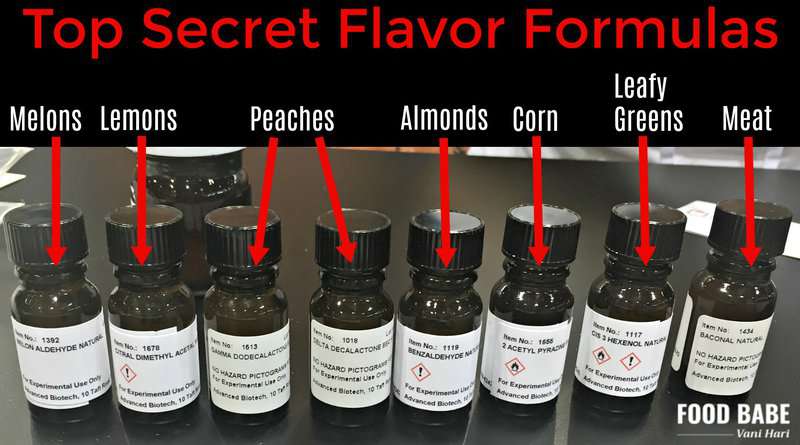
I bet that if you head to your kitchen right now and grab the first packaged food you see, you'll spot the word "flavor" somewhere on the ingredient list. Am I right?
Yes, the processed food industry adds flavors to nearly everything. When food undergoes heavy processing in factories, gets loaded with preservatives, and is shipped across the country to sit on a shelf for months, it loses its natural taste. That's why the flavor industry—a multi-billion-dollar business—is dedicated to creating chemicals that make processed food taste like… well… real food.
These flavors don't just make fake food taste authentic; they also give it a special "kick" that keeps you coming back for more. The natural and artificial chemicals engineered by flavor manufacturers contribute to what David Kessler (former head of the FDA) calls a "food carnival" in your mouth. The inability to stop eating arises because the synthesized flavors trick your brain into craving more and more.
Why do Americans consume more calories than any other industrialized nation? It's not because we have more money or are hungrier. It's because our food supply is chemically produced and enhanced with these "flavors," and they are everywhere—and we are being targeted.
You see, they don't want you to experience the full essence of a strawberry; they want you to taste only the best one-millionth part of it. This makes you "addicted," so you keep going back for more, endlessly seeking gratification, eating more of that product, and filling Big Food Companies' pockets. The Big Food Companies are "hijacking" your taste buds one by one.
The term "flavors" on a package is highly misleading. It sounds innocent and appears on so many products that we've become desensitized to it. Flavor companies own these proprietary formulas, making it nearly impossible to know exactly what's in them. You might think "natural apple flavor" is just some juice extracted from an apple and added to the food. Not quite. That "natural apple flavor" needs to be preserved and stabilized, and agents are added to help it mix well into a product. This is why flavors can contain upwards of 100 ingredients like propylene glycol, polysorbate 80, BHT, and BHA—all considered "incidental additives" that the FDA doesn't require to be labeled. The FDA doesn't require companies to tell you what's in the flavors they use. It's a complete mystery ingredient.
Who is overseeing the safety of flavors in our food? You may be surprised…
The fox is guarding the hen house. You see, no governmental or independent agency approves or oversees the safety of food flavors. Instead, the Flavor and Extract Manufacturers Association (FEMA), a flavor industry trade group, has assembled its own "independent" panel of scientists who review and approve new flavors as Generally Recognized As Safe (GRAS). These scientists are paid by the FEMA trade group, which ultimately gets its funding from flavor companies.
And, of course, these FEMA panel scientists are supposed to be independent and free of conflicts of interest, but many questions have been raised about their closed-door evaluations and lack of transparency with the public. The fact that this panel is assembled and paid for by a flavor company trade group is concerning to say the least, don't you think?
Public advocacy groups have questioned FEMA's processes and called on the FDA to ban certain flavor substances with known links to cancer, but little has been done. Some chemicals used to make flavors, like Diacetyl (which creates buttery flavor), are highly dangerous for those who work around them… but we are supposed to eat them and be okay? Consumers want to know what's in these flavors and what research has proven their safety, but we essentially get the door slammed in our faces when we ask.
The laws surrounding these flavors are lax to say the least, and companies don't have to tell you much about what they really are. Labels on food typically just say "natural flavors" or "artificial flavors" and don't explicitly explain the differences between them.
It's good to know that there are some stark differences between artificial flavors, natural flavors, natural strawberry flavors, organic raspberry flavors, natural essences, organic extracts, etc. And while these are all largely the same, some flavors added to food are better than others.
Not all flavors are equal…
So, if you're like me and want to understand exactly what you're eating and know more about what these labels all mean, I created this Flavor Cheat Sheet below to break it all down.
Now let's go over some real-world product examples, starting with the worst flavors in our food… Artificial Flavors.
Artificial Flavors or Artificial "X" Flavors
(Note: "X" stands for a specific flavor such as "Strawberry" or "Vanilla")
Artificial flavors are chemical mixtures made with synthetic (not natural) ingredients in a lab. They're produced by fractional distillation and chemical manipulation of various chemicals like crude oil or coal tar. Artificial vanilla flavor can be made from wood pulp. With artificial flavors, chemists can make anything taste like a strawberry without any actual strawberries (or any actual food for that matter), which is a really horrible thing if you care about health. But it's a great thing for food manufacturers because artificial flavors are much cheaper than using real food (or even natural flavors).
Natural Flavors
Natural Flavor is practically the exact same thing as Artificial Flavor, but it's derived from substances found in nature (plants, animals, etc). So, the flavor is DERIVED from natural things, but it's important to remember that this isn't all it contains. Remember, flavors typically contain preservatives, emulsifiers, solvents, and other "incidental additives," which can make up 80% or so of the formulation. Some of the most common incidental additives in flavors include sodium benzoate, glycerin, potassium sorbate, and propylene glycol (none of which are labeled).
Chemists create these complex formulations in a lab, isolating and blending specific flavors extracted from upwards of hundreds of compounds, some of which may be GMOs. These compounds can come from substances that are nowhere close to the actual thing. For example, they might take some castoreum from a beaver to make a flavoring that resembles a raspberry—without ever using any raspberries. But, hey, it's "natural" because it's from a beaver.
Image Credit: Science in the News, Harvard Graduate School of the Arts and Sciences.
Natural "X" Flavor
In general, if you see something like "Natural Cinnamon Flavor," this means the flavor is derived solely from the named fruit, vegetable, animal, or plant—in this case, cinnamon. In other words, if you see "Natural Raspberry Flavor" on a product, the flavor didn't come from a beaver but from actual raspberries. The reason food companies use this kind of flavoring is that it's cheaper than using the actual ingredient in its raw form. The flavor can also be synthesized to be the best "one millionth" part of the taste of a substance—something definitely not found in nature. Incidental additives still apply, of course.
Natural and Artificial "X" Flavor
You'll see a label like this when both natural and artificial flavors are in a product. It doesn't necessarily mean any of the named source (e.g., a cherry) is used.
"X" Flavor, with other natural flavor
Sometimes on the front of a package, you'll see the statement "Raspberry Flavor With Other Natural Flavor"—which sounds redundant. This means the food contains a flavor derived from raspberries, but ALSO other natural flavors that don't come from raspberries. This doesn't need to be disclosed on an ingredient list but is required on the front panel of the package if they want to describe the flavor on the front.
Organic Natural Flavor
A lot of people have told me they're surprised that organic foods can contain natural flavors. While it's not ideal, at least "Organic Natural Flavor" is made just like other organic ingredients and must follow the same regulations. That means organic flavors won't contain synthetic solvents or preservatives, and no GMOs. Some of the "incidental additives" banned from organic flavors include propylene glycol, mono and diglycerides, BHT, BHA, and polysorbate 80.
Natural Flavors (in a "USDA Certified Organic" Product)
Sometimes you'll just see "natural flavors" listed on a certified organic product (instead of "Organic Natural Flavors"). This means the flavor itself is not organic, but it is compliant with organic regulations—such as no synthetic ingredients or GMOs. So, ultimately, these flavors will have a cleaner profile than the average natural flavor in a conventional product.
Natural Flavors (In a "Made With Organic X" Product)
In products that don't carry the USDA Certified Organic label but are made with some organic ingredients, they still need to use organic "compliant" flavors. This means the flavors in any product labeled as "Made with Organic" ingredients can only contain flavors that are compliant with organic regulations as far as no GMOs, sewage sludge, or ionizing radiation used, and also cannot contain synthetics or artificial preservatives. However, the flavors themselves do not need to be certified organic.
Natural Essences and Organic Essences
An essence captures the hint of flavor from a fruit or vegetable. To make a strawberry essence, for instance, they may start with a strawberry juice concentrate and heat it to collect the steam, which becomes the essence. It should contain no additives or other ingredients.
"X" Extract or Organic "X" Extract
An extract is as pure a flavor as you will get and the closest thing to real food. It's similar to how you could make homemade vanilla extract by putting vanilla beans in an alcohol solution to extract the flavor. Due to how extracts are produced, they can have some nutrients in them too. Organic Lemon Extract is derived solely from organic lemons and is in compliance with organic regulations (no GMOs, no synthetic preservatives, etc).
I hope this helps you sort out all the added flavors, essences, and extracts in our food.
Sections
Please share this post with all your friends and family—everyone deserves to know what's behind these added flavors.
Xo,
Vani
Posts may contain affiliate, sponsorship, and/or partnership links for products Food Babe has approved and researched herself. If you purchase a product through an affiliate, sponsorship, or partnership link, your cost will be the same (or at a discount if a special code is offered) and Food Babe will benefit from the purchase. Your support is crucial because it helps fund this blog and helps us continue to spread the word. Thank you.
fbq('init', '121489361576387'); fbq('track', "PageView");
READ Surprisingly, Farmed Salmon Is One Of The Most Toxic Things You Can Eat
foodbabe.com