Claudia Geib, Futurism
People at the dawn of the 1900s held great optimism for what innovation would deliver. Technologies emerging from World War I, combined with the expanding reach of electricity (half of U.S. homes had electric power by 1925), inspired many to envision the century ahead. Early futurists anticipated an extraordinary technological surge that would dramatically improve human existence.
In reality, many of their predictions for our present era were remarkably close, ranging from the widespread use of cars and planes to the rapid exchange of information. Naturally, the exact workings of these inventions sometimes missed the mark. Nevertheless, these forecasts highlight just how far our technology has advanced in one hundred years—and how much further innovation could carry us.
Calling the Future
On a chilly February day in 1917, legendary inventor Alexander Graham Bell delivered an inspiring address to the graduating class of McKinley Manual Training School—words that would later seem almost prophetic. “Now, it is very interesting and instructive to look back over the various changes that have occurred and trace the evolution of the present from the past,” Bell said, after reflecting on the incredible shifts brought by electricity and automobiles alone. “By projecting these lines of advance into the future, you can forecast the future, to a certain extent, and recognize some of the fields of usefulness that are opening up for you.”
In 1876, Bell had secured a patent for the telephone, a device that transmitted human speech via wires. As the invention spread, its capabilities enabled voices to travel vast distances. By 1915, a “wireless telephony” system allowed a man in Virginia to converse with someone in Paris while another person in Honolulu listened in—spanning 4,900 miles (about 7,886 kilometers) and setting a record for the longest-distance communication at the time.
Bell placing the first New York to Chicago telephone call in 1892. Image Credit: Gilbert H. Grosvenor Collection, Prints and Photographs Division, Library of Congress
Bell marveled at this accomplishment and the transformation it had already sparked, predicting that “this achievement surely foreshadows the time when we may be able to talk with a man in any part of the world by telephone and without wires.” When Bell gave his speech, the U.S. had roughly 11.7 million working telephones; by the year 2000, that figure had climbed to nearly 103 million.
Extending the trend, Bell envisioned a future where this technology enabled people to perform almost any task remotely: “We shall probably be able to perform at a distance by wireless almost any mechanical operation that can be done at hand,” he stated. And he was correct.
Transportation of the Future
A century ago, people were captivated by the idea of future travel. By 1914, Ford Motor Company had introduced the first moving assembly line, enabling the production of 300,000 cars in a single year. As transportation began reshaping society, futurists imagined a world where everyone from Miami to Moscow could own a personal automobile. In that respect, they were quite accurate—95 percent of American households own cars, according to a 2016 government report. However, the cars they pictured looked rather different from today’s vehicles.
An illustration from the 1918 Scientific American article “The Motor Car of the Future.” Image Credit: Scientific American
On January 6, 1918, a headline in The Washington Times declared that the “Automobile of Tomorrow Will Be Constructed Like a Moving Drawing Room.” The piece referenced a prediction from Scientific American describing the car of the future: watertight and weatherproof, with sides made entirely of glass, seats that could be repositioned anywhere inside, and features like power steering, brakes, heating, and a small navigation control board. A finger lever would replace the steering wheel. Other designs envisioned cars rolling on just three wheels, or on air-filled spheres to eliminate the need for shock absorbers.
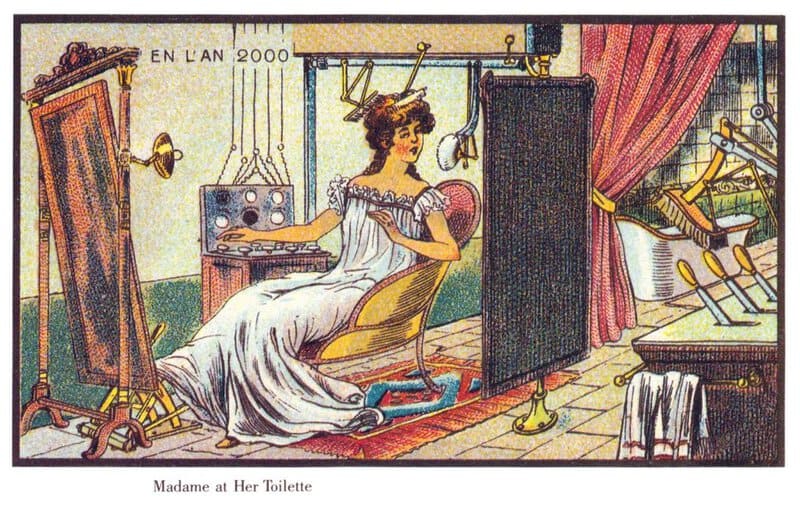
Early 1900s futurists were also fascinated by the idea that everyday travel wouldn’t be limited to land. Consider the series of postcards produced between 1899 and 1910 by French artist Jean-Marc Côté and his collaborators. They seemed confident that by the year 2000, humans would have colonized both the sky and the sea—and even recruited some of their inhabitants for our transport needs.
Image Credit: Wikimedia Commons
Air travel dominated people’s imaginations: the Wright brothers achieved the first powered airplane flight in 1903, inspiring countless inventors and engineers to test numerous aircraft designs before World War I. So it’s no surprise that Côté’s miniature works envisioned nearly every form of transportation in the year 2000 as airborne. Aerial taxi services, floating dirigible battleships, a flying postman, and air-based public transit all appear in these whimsical depictions of our predicted present.
Some concepts, like an aerial rescue service or planes designed for combat, are now routine parts of military forces (though we still lack the “French invisible aeroplane” that Scientific American promised in 1915).
Other anticipated technologies, such as personal flight devices enabling humans to hunt or play tennis in the air, might become reality in the near future once jet packs are available.
Artist Albert Robida imagines (circa 1882) a night at the opera in the year 2000, by which time we would all have personal flying cars. Image Credit: Wikimedia Commons
Indeed, personal flying machines are a recurring theme in 19th- and 20th-century visions of the 21st century—especially the notion that personal flying cars would become commonplace. Forward-looking Victorians, like artist Albert Robida in 1882, assumed the skies would be thick with flying cars by 2018.
In the May 1923 issue of Science and Invention, science fiction writer Hugo Gernsback described his vision for these flying cars, which he called the “helicar,” as a solution to the automobile traffic already clogging New York City’s streets:
The only practical solution is to combine the automobile with an airplane and this no doubt will happen during the next few decades. The Helicopter Automobile or, for short, the helicar, will not take up very much more room than the present large 7-passenger automobile, nor will it weigh much more than our present-day car, but instead of rolling down the avenue, you will go straight up in the air, and follow the air traffic lines, then descend at any place you wish.
We may not yet have a flying machine parked in every garage, but organizations like Uber and NASA, the Russian defense company Kalashnikov, Toyota for the 2020 Olympics, and numerous smaller companies are developing personal flying cars, so this too may not be far off. Alexander Graham Bell addressed the possibility of air transportation, noting that travel by boat was cheaper than by rail because no tracks needed to be laid. Bell suggested that a “possible solution of the problem over land may lie in the development of aerial locomotion.” He added: “However much money we may invest in the construction of huge aerial machines carrying many passengers, we don’t have to build a road”—a sentiment echoed by one of his fictional successors.
Technology Gets Personal
In 1900, Smithsonian curator and writer John Elfrith Watkins, Jr., penned an article titled “What May Happen in the Next Hundred Years” for The Ladies’ Home Journal. Looking ahead at the fresh new century, Watkins imagined a world where technology wasn’t confined to industry or the military—instead, it would be harnessed to entertain and convenience everyday people.
Though he didn’t foresee television in its current form, Watkins predicted that technology would one day bring distant concerts and operas into private homes, sounding “as harmonious as though enjoyed from a theatre box,” and that “persons and things of all kinds will be brought within focus of cameras connected electrically with screens at opposite ends of circuits, thousands of miles at a span.” He also anticipated that color photographs would be rapidly transmitted around the world, and that “if there be a battle in China a hundred years hence snapshots of its most striking events will be published in the newspapers an hour later.” One can only imagine what he would have thought of the selfie.
Jean-Marc Côté’s 1910 imaginings of the “correspondence cinema” of the 21st century aren’t too far from today’s Skype or FaceTime. Image Credit: Wikimedia Commons
Watkins envisioned technology transforming our homes and diets. Although the mechanically cooled refrigerator wasn’t invented until 1925 and didn’t become widespread until the 1940s, Watkins correctly predicted that “refrigerators will keep great quantities of food fresh for long intervals,” and that “fast-flying refrigerators on land and sea” would deliver fruits and vegetables from around the world, providing out-of-season produce. He even foresaw fast-food delivery, anticipating “ready-cooked meals… served hot or cold to private houses.” He believed these meal deliveries would completely replace home cooking (for some city-dwellers with Seamless accounts, that’s not far off), and might arrive via pneumatic tubes as well as “automobile wagons.”
Some of Watkins’ predictions were close to reality, but he was quite off about other aspects of 21st-century life. He thought humans would have exterminated pests like roaches, mice, and mosquitoes, as well as all wild animals, which would “exist only in menageries.” This prediction was surprisingly common in the early 1900s, perhaps a reaction to recent extinctions like the quagga (1883), the passenger pigeon (1914), and the thylacine (1934). Though we are now experiencing another global extinction driven by human activity, we can be thankful we haven’t reached the level of extinction most Victorian futurists expected.
Watkins also believed we would have eliminated the letters C, X, and Q from the everyday alphabet as “unnecessary”; and that humans would essentially turn ourselves into a super-species, with physical education starting in the nursery, until “a man or woman unable to walk ten miles at a stretch will be regarded as a weakling.” Unfortunately, our global obesity problem shows the reality was quite the opposite.
Thematically, however, these predictions are sound: as electricity use spread and technologies like automobiles and telephones became more affordable, Watkins could envision an age where technology was fully integrated into our lives. To early 1900s futurists, it seemed obvious that robots and automation would be essential to 21st-century people, serving as chauffeurs, cleaning houses, scheduling laundry, and even electrically transmitting handshakes.
Image Credit: Wikimedia Commons
Alexander Graham Bell also predicted this trend, and he believed it heralded something particularly promising for the McKinley graduates he addressed in 1918. Foreseeing the rise of a technology-centered industry and an exploding need for scientists and engineers, he told them: “It is safe to say that scientific men and technical experts are destined in the future to occupy distinguished and honorable positions in all the countries of the world. Your future is assured.”
A Future of Clean Energy
Perhaps the most surprising predictions from the past century concern fossil fuels and the environment. Yes, today some people still resist transitioning away from fossil fuels and ignore the scientific consensus on climate change. But bright minds of the early 20th century were already theorizing that we would one day have to break our fossil fuel habit.
The city of the future, as illustrated in a 1928 edition of Popular Mechanics, would see traffic re-routed below ground to avoid congestion. Image Credit: Popular Mechanics
As early as 1896, scientist Svante Arrhenius calculated that doubling the concentration of carbon dioxide in the atmosphere would raise Earth’s temperature by 8 to 9 degrees Celsius. Arrhenius was inspired by the startling discovery of his friend Arvid Högbom, who realized that human activities were releasing carbon dioxide at roughly the same rate as natural processes.
Because of the rate at which industrial countries burned coal in 1896, Arrhenius believed human-caused warming wouldn’t reach problematic levels for thousands of years. But by the time he published his 1908 book Worlds in the Making—an attempt to explain the evolution of the universe to a popular audience—that rate had increased so much that Arrhenius was convinced the amount of carbon dioxide in the atmosphere could double within a few centuries.
Scientists as a whole wouldn’t embrace Arrhenius’ ideas or recognize that burning carbon-based fuels had an adverse effect on our planet for at least a century. Yet even before scientists understood the climate effects of fossil fuels, futurists were predicting we would have to drop our use of coal and oil before long. “Coal and oil are going up [in usage] and are strictly limited in quantity,” Alexander Graham Bell said in his February 1917 speech. He continued:
We can take coal out of a mine, but we can never put it back. We can draw oil from subterranean reservoirs, but we can never refill them again. We are spendthrifts in the matter of fuel and are using our capital for our running expenses. In relation to coal and oil, the world’s annual consumption has become so enormous that we are now actually within measurable distance of the end of the supply. What shall we do when we have no more coal or oil!
He went on to note that hydropower was, at the time, limited, and implied that one day it might be possible to generate energy from tides or waves, or “the employment of the sun’s rays directly as a source of power.”
Bell wasn’t the only one certain we would need to find a new energy source in the next century. In 1917, when a severe coal shortage in the U.S. prompted calls for conservation, one writer for the Chicago News asserted that stockpiling coal would ultimately be foolish. He insisted that worrying about the coal supply would soon be like fretting over the supply of tallow candles: pointless.
“These gifted lunatics who are worrying about the coal supply are in the same class,” the Chicago News writer insisted. “It doesn’t occur to them that in a hundred years people will be saying, ‘Our grandfathers, the poor boobs, actually used coal for heating purposes!’”
We’re not laughing quite yet. According to the U.S. Energy Information Administration (EIA), the U.S. still gets 17 percent of its energy from coal. Another 28 percent comes from petroleum products, and 33 percent from natural gas; we get only 12 percent of our electricity from the renewable sources that the Chicago News writer—who was sure we’d find a way “to put the sun’s energy in storage, and pump it into people’s houses thru pipes”—predicted by now. Globally, coal makes up about 27 percent of the world’s energy production, and renewable energy about 24 percent.
The good news is that this distribution is changing as renewable energy becomes cheaper than fossil fuels, edging us ever closer to the bright future that 20th-century minds thought we’d be living in. Fingers crossed the whale-bus will be next.
Source