Robert Dingemanse has grown accustomed to the frequent comparisons. The Jetsons, Harry Potter, James Bond.
As the head of a Netherlands-based company creating a flying vehicle, he is familiar with curious onlookers whose only reference points for his innovation come from animated series or cinema.
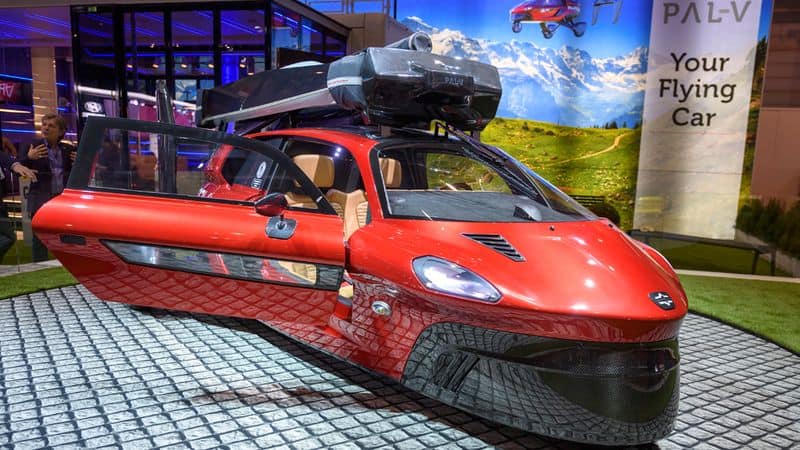
However, starting this week, Mr. Dingemanse’s ambition to offer commuters—particularly affluent ones—the option to either drive or fly to work takes a major leap forward. He is showcasing the initial production version of the PAL-V Liberty, a hybrid three-wheeled, two-seat automobile and gyroplane, at the Geneva motor show.
The PAL-V Liberty Flying Car is unveiled during media previews at the 88th Geneva International Motor Show in Geneva. (AAP)
“Flying cars have been depicted in movies countless times, and they will become a reality next year,” Mr. Dingemanse told The Associated Press at an airport near Breda in the southern Netherlands, standing beside a glossy black prototype of the PAL-V Liberty.
The PAL-V Liberty joins several other flying cars under development globally, such as The Transition, a folding-wing two-seater by US-based Terrafugia, and an all-electric vertical take-off and landing jet from German startup Lilium.
Carlo van de Weijer, director of the Smart Mobility program at Eindhoven University of Technology, views flying cars as little more than a niche market.
“It’s not going to become a significant segment of the overall mobility industry,” he said. “It’s an interesting novelty to pair with a car, so… it could be a successful company selling a decent number,” he remarked about the PAL-V.
In flight, the PAL-V is propelled by a rear-mounted propeller driven by two engines. Stability is provided by a larger roof-mounted rotor that enhances safety.
Developers of the vehicle say it will be available next year. (AAP)
“The rotor isn’t powered,” Mr. Dingemanse explained, “so it functions like a parachute that’s always available.”
Its creators state the PAL-V can drive up to 170 kilometers per hour, fly up to 180 km/h, and cover about 500 kilometers on a single tank of regular unleaded gasoline.
Upon landing, the rotor and propeller fold away, the tail retracts, and the PAL-V is ready for road use. Converting from road to aircraft mode takes roughly 10 minutes, including necessary checks, according to the company.
With an anticipated price of around 500,000 euros (A$793,500) for the first production run of 90 units, these flying cars aren’t for everyone, but Mr. Dingemanse says he already has many buyers lined up.
The PAL-V Flying Car. (AAP)
Buyers will need to become certified gyroplane pilots to take their PAL-V into the skies, and the company also offers training courses.
However, don’t expect this flying car to lift off vertically if stuck in traffic. The PAL-V requires a short runway or grass airstrip for takeoff and landing.
With the first production model ready, the company can now begin the final certification stages with road and aviation authorities in Europe and beyond.
Source: