“Whoever tells the stories, defines the culture.”
My eldest son and his buddies have been binging The Who Was? Show on Netflix lately, a program that takes viewers through the biographies of notable historical figures. Just before supper the other night, he enthusiastically rattled off every individual he had discovered that day. Once he finished, he offered this simple yet striking remark: “That was a lot of white people I guess!”
To give credit where it's due, the series and its source books do a reasonable job of showcasing a diverse lineup of historical “heroes.” Still, that hasn't been the norm for much of mainstream media and literature. Across generations, and in countless classrooms even now, white history has been presented as American history itself (frequently delivered by white educators, since the teaching workforce is considerably less racially mixed than the student populations they serve). And the issue stretches far beyond simply spotlighting white icons. Journalist Alia Wong noted in The Atlantic that as late as 2015, an American schoolbook characterized the transatlantic slave trade as transporting “millions of workers from Africa to the southern United States to work on agricultural plantations.”
Sweeping painful chapters of our troubling history under the rug and repackaging them is a perilous narrative to pass along to young people.
“But what else can I say? The truth is just too much for them.”
This worry is common among white mothers and fathers. Most white caregivers in America either postpone these discussions for years, waiting until they feel their kids are “ready,” or embrace a colorblind stance, assuring their children that “they don't see color.”
A recent survey revealed that three-quarters of white parents say they rarely or never bring up race. Parents of color, by comparison, are three times as likely to discuss race with their kids. Author Jemar Tisby points out that “Though all parents are vigilant about keeping their children safe from harm, “Black parents, on top of that, have to worry about shielding their children, and healing them, from antiblack racism” making conversations about race unavoidable.
In Between the World and Me, Ta-Nehisi Coates addresses his son directly: “I did not tell you that it would be okay, because I have never believed it would be okay. What I told you is what your grandparents tried to tell me: that this is your country, that this is your world, that this is your body, and you must find some way to live within all of it.”
Plenty of white mothers and fathers long to smooth things over by sidestepping race, hoping to shield their little ones from developing bias and prejudice. The desire makes sense, but the damage it causes to our shared culture is significant. Glancing at my own four-year-old, it's tough to picture him wrestling with concepts of race when even taking turns with toys feels like a tall order. The catch is that racism saturates the atmosphere American children inhale, so steering clear of the subject doesn't shield him from it. It just entrenches it.
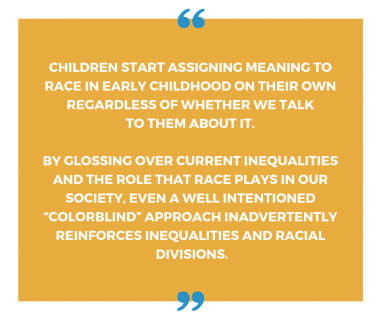
On top of that, studies confirm that kids begin attaching meaning to race in their earliest years on their own, whether or not grown-ups address it with them. Skipping over present-day disparities and the function race serves in our culture, even with the most well-meaning colorblind stance, unintentionally cements inequities and divisions.
Black History Month: A Door Worth Opening
February has rolled around again, and students nationwide will be exploring Black contributions to U.S. history in countless ways. I vividly recall gathering in the gym with my elementary school peers, captivated as Mr. Howl delivered a stirring rendition of Dr. King's I Have a Dream speech. Looking back, it's obvious that countless other addresses, figures, and narratives were left out of the picture.
When executed thoughtfully, educational institutions can elevate and spotlight the frequently overlooked narratives, contributions, and resilience of Black individuals and neighborhoods. When done right, Black learners gain greater chances to “talk back” to and challenge the prevailing storylines that have placed whiteness at the heart of academic content and school life. When handled well, schools and neighborhoods can hold meaningful discussions about how to follow Black leadership throughout the entire year, not just during one winter month. And when executed properly, parents can link up with their kids around what they're absorbing in class and tackle subjects of race and racism in the household.
The encouraging part is that parents who address race can actually shape more positive racial attitudes in their children compared to those whose parents sidestep the topic. One significant piece of research discovered that the kids who displayed the least bias by age six were those whose families had spoken with them about race.
Beyond that, we as parents ought to seize this chance to do our own studying too. The hitch is that most schools during Black History Month focus on lone historical figures, watered-down speeches, or celebrated innovations. Though a decent beginning, evidence indicates that this style of multicultural programming doesn't go nearly far enough to challenge racial bias in young people. For instance, simply reading biographies of accomplished people of color doesn't improve racial attitudes as effectively as understanding the oppression and resistance those same individuals endured.
Put another way, grasping the backdrop of resistance early on serves as a potent countermeasure to racism.
“That was a lot of white people, I guess!”
Honestly, as a white mother, my son's offhand comment stirred up a familiar small jolt of unease, the product of a lifetime of cultural colorblind messaging. Over the years I've worked to read those jolts not as cues to clam up but as hints that growth is on the horizon.
In that moment, I simply reflected his own observation back: “You are right! That is a lot of white people! What do you think of that?” With the righteous indignation typical of a second grader, he declared that it didn't really mirror the actual world and asked, “Who decides these things?” – a query we can unpack for years.
In case you're picturing an extended period of soul-searching and critical examination, let's be real: after a few more exchanges, he promptly declared “Okay! Let's talk about something else now!” (which is also entirely second-grade-appropriate). From there we shifted to hunting down episodes that featured more than just white characters.
Conversations about race and racism aren't a one-time event, and they evolve as our children mature. There's no need to draft a speech (seriously, don't) or compose a sweeping essay on tearing down racism. What we do need is the willingness to keep the dialogue going, pose questions, and stack up new layers of insight into how race molds the world around us.
If you're unsure where to begin, that's perfectly fine. Uncertainty comes with the territory of parenting, and we rarely have all the responses ready for our kids. This is no exception. What I am certain of includes the following:
- Spotting and naming whose perspectives and voices take the spotlight and whose get pushed to the edges is a vital capability.
- Passing along the genuine political circumstances and struggles of our cultural icons matters deeply. We have to dig and keep practicing to sharpen this skill.
- Growth demands discomfort, yet we all gain from the hard, humbling, and ultimately enriching labor of broadening the circle of those we care about.
- Our children are frequently prepared before we are.
- We cannot wrap things up when the calendar turns to March.
DO:
- Reflect. How has race influenced your own journey? Did conversations about race happen in your household growing up? Why or why not? Do you bring it up now? What supports or hinders those talks? What visuals does your child encounter in your living space?
- Get started. If this is uncharted territory for you, try beginning with the next book you crack open. Label white characters as white, and so forth. Begin where you stand and press forward.
- Name differences and similarities as you read and tell stories. Overlooking race, ability, or class simply hands more influence to stereotypes and prejudice. Discuss commonalities and shared values without erasing distinctions.
- Support Black, Indigenous, and People of Color owned businesses, movements, media, music, and art in your home.
- Cultivate a diverse library. Don't just look for Black and brown faces. look for stories that have multidimensional, complex characters with agency. Use resources like weneeddiversebooks.org for ideas.
- Model curiosity. When you don't have all the answers, show your child that you care enough to find out more.
- Talk to your child's school. Learn more about the school's plan for Black History Month and about centering Black, Indigenous, and people of color in curriculum year round.
- Check out:
DON'T
- Limit your action to just talking. Children watch what we do more than what we say and are learning from the ways we interact with others in the places we worship, shop, learn, govern, and build community.
- Assume that not talking about race and racism (or sexism, homophobia, etc…) will make it go away.
- Expect POC teachers, friends, or colleagues to do the heavy lifting. Your children need to see you building your own skill set in talking, learning, exploring, and facing truths.
- Let your discomfort, worry, guilt, defensiveness or uncertainty get in the way of growth. Works referenced: 1. Brown et. al. (2006). Child, Parent, and Situational Correlates of Familial Ethnic/Race Socialization. Journal of Marriage and Family. 69(1), pp. 14-25. 2. Van Ausdale, D. & Feagin, J. (2002). The First R: How Children Learn Race and Racism. New York:Rowman and Littlefield. 3. Stain, S. (2017). White Families and Racial Socialization: A Review. American Cultural Studies Research Papers. 7. 4. Bigler, E. (1999). The Use of Multicultural Curricula and Materials to Counter Racism in Children. Journal of Social Issues. 55(4), pp. 687-705. 7. Weissbourd, R., et. al. (2014). The Children We Mean To Raise: The Real Messages Adults Are Sending About Values; Executive Summary. Cambridge, MA, Harvard Graduate School of Education. Making Caring Common Project. 8. Vittrup Simpson, B. (2007). Exploring the Influences of Educational Television and Parent-Child Discussions on Improving Children's Racial Attitudes. Dissertation submitted to University of Texas at Austin. Access at: 9. Katz, P. (2003). Racists or Tolerant Multiculturalists? How Do They Begin? The American Psychologist. 58. 897-909. Depression and Anxiety Might, In One Way, Be a Signal, Saying You Shouldn't Have to Live This Way