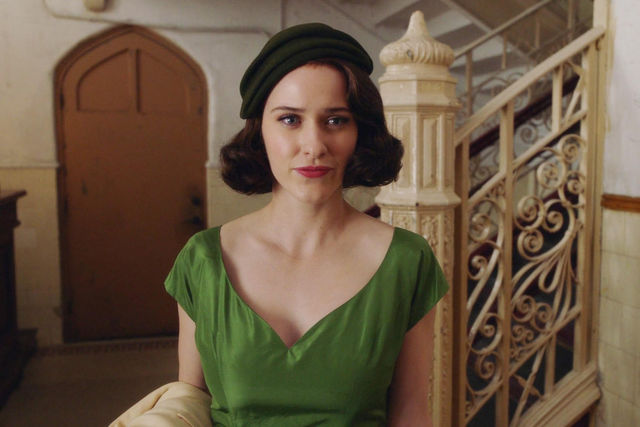
When Amazon decided to end Good Girls Revolt, I was quite annoyed. Apart from Transparent (which comes with its own complications — a subject for another piece), it felt like the platform wasn't prioritizing content aimed at the large female audience. However, Amazon has now given us The Marvelous Mrs. Maisel. The series features Rachel Brosnahan as the lead, Miriam (Midge) Maisel, and follows a 1950s homemaker who turns to stand-up comedy after a painful split from her spouse.
As a Jewish woman, I found it genuinely uplifting to see a Jewish female character take center stage in a TV series and be shown in a favorable way. Apart from Rachel Bloom's portrayal of Rebecca Bunch on Crazy Ex-Girlfriend, such instances are uncommon. Historically, Jewish women on television have been depicted as "loud, vulgar, spoiled, and unattractive," often reduced to unflattering stereotypes.
"When young Jewish women appear on screen, they usually match the stereotype of the pampered Jewish princess hunting for deals and a husband—ideally a wealthy doctor to support them (e.g., Fran Fine on The Nanny)—or they come across as dowdy and unattractive (Fran on Mad About You, Rhoda on The Mary Tyler Moore Show, Brenda on Rhoda)," notes Joyce Antler for My Jewish Learning.
"While jokes about Jewish princesses and Jewish mothers generate easy, instant laughs, this humor is harsh and distressing for Jewish women, undermining their self-esteem—especially among younger women who depend on media for role models—and shaping negative male perceptions of Jewish women," Antler continues. "Those outside the Jewish community who have limited exposure to Jewish women often take these stereotypes as truth."
The Marvelous Mrs. Maisel includes references to keeping kosher, holidays such as Yom Kippur, and other nods to Jewish culture. Given the significant rise in anti-Semitism over the past year, it's reassuring to see Jewish people portrayed positively.
Yet, unlike Rachel Bloom, who is Jewish, Brosnahan is not. The show's creator and writer, Amy Sherman-Palladino, had a Southern Baptist mother and a Jewish father, and has mentioned being raised "sort of" Jewish. Learning this tempered my enthusiasm for the series, but I still enjoyed it overall, despite a few odd moments that I doubt actual Jewish characters would accept. For example, in a later episode, Midge appears fairly comfortable with a man performing a Hitler impression. Considering the show is set in the late 1950s—barely a decade after World War II—that "joke" landed poorly.
I spoke with other Jewish women to get their perspectives on the show. "Representation is crucial, and not just the obvious Jews with kippahs and payot who stand out for obligatory inclusion, or the funny Jews who merely claim their identity, toss in a random 'oy vey,' joke about their noses and hair, and call that representation," says Ari Kras, a 31-year-old from Washington D.C. "This is genuinely one of the only mainstream shows where I've seen myself reflected."
However, others were less impressed, expressing disappointment with the casting decision (again, Brosnahan isn't Jewish) and the fact that Midge comes from an affluent Jewish family on New York's Upper West Side—a background that doesn't connect with working-class Jews. In fact, a 2013 report revealed that roughly 30% of all New Yorkers in Jewish households live in poverty or near-poverty. Over the last two decades, this figure has nearly doubled—from 70,000 impoverished Jewish households in 1991 to 130,000 in 2011. About 90% of poor Jewish households are located in New York City. In 2012, only 7% of New York Jewish households reported annual incomes of $250,000 or more, while 42% earned under $50,000. According to The Forward, 37% of households said they were "just managing" to get by. These statistics primarily affect the elderly, children, the disabled, and single-parent households. "Poverty in the Jewish community is rising at an alarming pace, much faster than the Jewish community as a whole," writes Dr. Jacob B. Ukeles, who led the 2011 report on Jewish poverty.
"Personally, I can't relate to the Upper West Side setting and the Columbia professor [Midge's father] and well-traveled upbringing. I would have enjoyed the show much more if it were set in, say, Astoria, in a more blue-collar, first-generation family that is likely more representative of most Jewish people," says Addison Levy*, a 24-year-old living in Florida.
"My only thought about [the show] is that it doesn't truly represent Jewish women," says Sylvanna Seydel, a 40-year-old from New Mexico. "The actress playing the lead isn't Jewish, but apparently believes that growing up in a Jewish neighborhood qualifies her to play a Jewish woman," she adds, referencing Brosnahan's upbringing in Chicago's Jewish Highland Park area.
"Casting a [non-Jewish woman] to play a Jewish heroine and martyr is a particularly goyish kind of nonsense," Seydel asserts. "I'm actually boycotting all movies and TV shows that tell Jewish stories without casting actual Jews. The only times Jewish actors get cast as Jewish characters are when we play villains or comic relief. We never get to be the heroes of our own narratives, and I'm completely done with it."
"I was somewhat let down by the representation," says Grace Goldman*, a 22-year-old from New York. "I would have preferred a more blue-collar Jewish New York story. Even most of the wealthiest Jewish families I know come from that kind of background, including mine."
"Also, I was disappointed about the non-Jewish actress, knowing from experience that working in the industry as a Jewish actress often means 'Jew-y' Jewish girls always get character roles (not 'Jewish-looking' Jewish girls), receive praise, and land ingenue-type parts," she continues.
Overall, I enjoyed the show. Midge emerges as a pioneer for female comedians, similar to how Good Girls Revolt focused on pioneering female journalists. Set in the 1950s, Midge takes the stage to discuss female sexuality—definitely a taboo subject back then. Additionally, the series portrays the unraveling of the "proper" female lifestyle—marrying right after college and becoming a stay-at-home mother who never has to lift a finger. In the 1950s, long before divorce was common and single working mothers were typical, Midge considers leaving her husband. She takes a job at a department store and still finds time to pursue comedy. She defies the era's "norm" of womanhood. In this sense, Midge can be viewed as an icon of breaking conventions.
However, for season two (which has already been confirmed), I hope the writers and producers seek input from actual Jews—especially those who lived in 1950s New York. And perhaps, just perhaps, they'll cast real Jewish actors for new roles on the show.
- = A pseudonym was used for the last name at the request of the interviewee
Top photo: The Marvelous Mrs. Maisel/Amazon
More from BUST
BUST’s 10 Best Bets For Winter 2017
Week Of Women: November 24-30, 2017
“Gilmore Girls: A Year In The Life” — The Good, The Bad, And The WTF