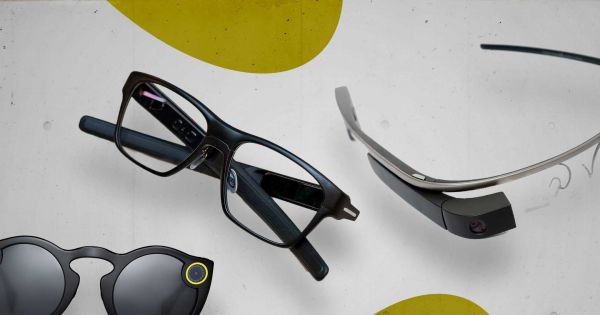
Intel's Vaunt smart glasses could succeed where Google Glass flopped. The Vaunt uses a gentle laser that fires directly onto the user's retina to surface incoming notifications.
The journey to wearable face-computing has been bumpy. Google Glass kicked things off, with Snapchat Spectacles following. Both were pitched as revolutionary — bringing the web as close to our eyes as physically possible. Neither took off: too costly, too stealable, too awkward-looking — and both slipped quietly into the tech reject pile alongside Segways and K-cups.
A new contender is now sizing up the challenge that has humbled so many before it. Intel, the company behind those (sometimes flaky) processors, just rolled out its own smart eyewear.
There's genuine reason to think Intel might crack the code this time. Per The Verge, the Vaunt drops the camera, speakers, microphone, buttons, and LCD display — the mission isn't to bolt a smartphone to your head. Every electronic component fits into a tidy module perched above the wearer's ear. Commands come through gentle head tilts, which one would hope have enough smarts to avoid accidentally messaging your ex while you bob to whatever's pumping through your earbuds.
The frames barely register on your face, weighing in around 50 grams (just under 2 ounces) — roughly the heft of five Oreo cookies.
Lightweight doesn't mean stripped-down, though. The Vaunt packs a processor, accelerometer, Bluetooth chip, and compass inside, according to TechCrunch.
A close look at the components running along Intel's Vaunt frame. Image Credit: Vjeran Pavic/The Verge.
A laser unit tucked inside projects a tiny image straight onto a corner of the retina. That image functions as a display, surfacing phone alerts, walking directions, or a reminder to call mom on her birthday. If getting zapped in the eye with a laser sounds off-putting, Mark Eastwood, industrial design lead for Intel's New Devices Group, offered reassurance: "It runs at such minimal power that it sits at the very bottom of a class one laser." Based on U.S. Food and Drug Administration standards, that puts it in the clear for safe, prolonged viewing.
Equally significant, the Vaunt doesn't broadcast that it's smart eyewear. The aesthetic tilts more toward James Bond territory than Robocop. In practice, it does what a smartwatch does — except mounted on your face, shaving off the half-second it takes to raise your wrist.
Whether there's a market is almost beside the point compared to whether Intel can actually get these into production — there's no launch date, no price tag yet. Intel suggested it's more likely to license the design out to other firms for retail rather than selling the glasses directly. Honestly, that might be the shrewdest decision — letting some other outfit deal with the inevitable "lasers in eyeballs" headlines.