Written by Caroline Ednie, photographed by Sergio Pirrone
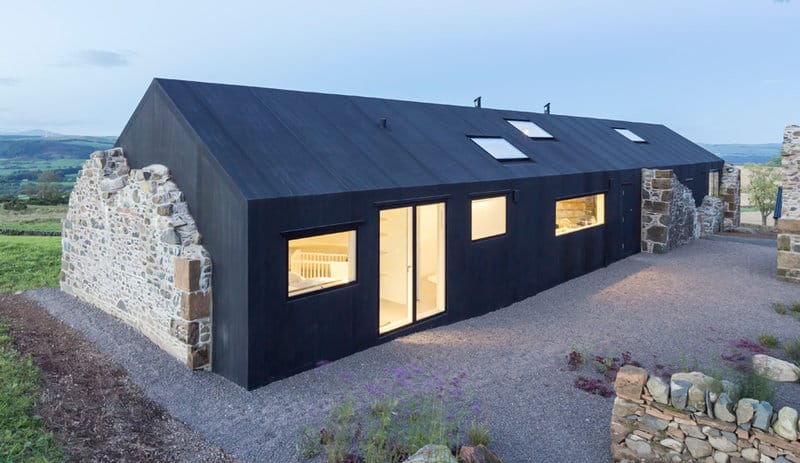
In Scotland, the weathered stone remnants of a barn serve as an improbable base for a residence defined by white surfaces and flowing curves.
When envisioning a secluded getaway amid Scotland's rugged countryside, one might picture a stark, windswept bothy. Ruins Studio defies that image entirely – it is the product of an architectural journey by Lily Jencks Studio and her frequent collaborator Nathanael Dorent of Paris.
Perched on a high ridge in Dumfriesshire's Southern Uplands, this private home commands views stretching over 80 kilometres down two valleys. It is not only a super-insulated, solar-panelled near-passive house, but also boasts interiors that are both lavish and sensuous.
The project originated from farmhouse ruins. “People have been living on the site since the 1720s,” explains Jencks, who before founding her own practice refined her interest in unconventional building methods while working at OMA in Rotterdam and Gehry Partners in Los Angeles. “Different parts of the site were built at various times. Some of the stone ruins were quite grand while others were used to house cattle. We wanted our design to be a continuation of this history, to add to that layering.”
Consequently, Ruins Studio is embedded within the existing ruin walls, which form the outer skin of the new structure. Inside sits a pitched-roof envelope clad in black, waterproof EPDM rubber. Within that lies a curvilinear “tube” wall system made of insulating polystyrene blocks inside a gridded wooden framework, covered with fibreglass.
The material choices were a deliberate effort to preserve history without replicating it, according to Jencks. “The matte rubber actually makes the building blend into the landscape, giving the ruins more power, I think. We didn’t want to compete with them by also building in stone. Instead, we created this dynamic juxtaposition.”
In certain areas, the structural framework is left exposed to create usable bookcases and storage.
As a counterpoint to the exterior angles, the interior features curvilinear forms that snake through the single-storey volume from gable to gable, morphing into bookcases, windows, and doorways along the way. The curves draw inspiration partly from the surrounding landscape. “The hills are quite undulating,” says Jencks, “so there’s a relationship between the walls and these beautiful elevations.”
The flowing walls and skylights offer a poetic counterpoint to the original stone foundations.
When seen in person, the contrast between interior and exterior is striking. “As soon as you open the door you are in this incredibly bright space,” Jencks notes. “The light that comes through the skylight bounces off the walls in a way I’ve never experienced before… and that becomes a way of indirectly exploring the landscape.”
Bedrooms at either end of the house are accessed through narrow passageways that lead to the kitchen and sitting room.
To realize the interior, extensive research was required during the design phase, with many model builds, says Dorent. “The framing had to be constructed in parts then assembled on-site. But the result is that the main living spaces actually appear larger than they really are. The curves, and the way the light hits them, seem to create this illusion.”
Ultimately, what matters is how well the space works as a family home. “It’s a retreat, a place to get away from it all,” says Jencks. “It’s also about framing the landscape, and that can really be felt when you’re there.”
Project Ruins Studio
Typology Two-bedroom getaway
Location Dumfriesshire, Scotland
Firms Lily Jencks Studio (London), Nathanael Dorent Architects (Paris)
Floor Area 180 sq. m
Site Area 10,000 sq. m
Floors 1
Furnishings Lily Jencks Studio, Carl Hansen & Søn, Neo 3p stove by ACR
azuremagazine.com