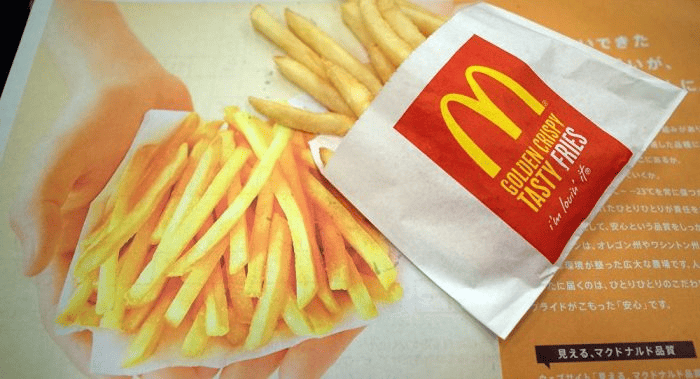
Craving fries and hoping for thicker locks? Indulging in that golden, salty side could do more than simply tame your appetite.
Source: Sputnik News
Those golden, salty, irresistibly crunchy McDonald's french fries could turn out to be more than a guilty indulgence. Japanese researchers suggest the popular side dish might play a role in fighting baldness.
According to findings released last week by Yokohama National University, scientists discovered that dimethylpolysiloxane—a silicone-derived compound that McDonald's mixes into its frying oil to stop splashing—can also trigger the formation of hair follicles. While McDonald's famously incorporates this ingredient, it isn't the only chain that relies on it. It also shows up in the kitchens of Taco Bell,
Domino's, Five Guys, Chick-fil-A, and KFC. The substance even appears in silly putty, though nibbling on that stretchy toy is strongly discouraged.
The team successfully generated up to 5,000 hair follicle germs (HFGs)—the tiny clusters from which hair sprouts—by using oxygen-permeable dimethylpolysiloxane as the growth medium. Once these HFGs were grafted onto the back skin of nude mice, they sprouted black strands of fur.
Professor Junji Fukuda, one of the study's authors at Yokohama National University, told Science News that dimethylpolysiloxane was "key for the mass production of HFG." The compound served as a culture medium and "worked very well," he added.
After the engineered HFGs were implanted into the backs and scalps of lab mice, fresh hair follicles and hair shafts emerged at the transplant sites.
"These self-sorted hair follicle germs were shown to be capable of efficient hair-follicle and shaft generation upon intracutaneous transplantation into the backs of nude mice," the paper states. The researchers are optimistic the same approach could eventually treat hair loss in people.
"This simple method is very robust and promising," Fukuda noted. "We hope this technique will improve human hair regenerative therapy to treat hair loss such as androgenic alopecia [male pattern baldness]."
—Sputnik News