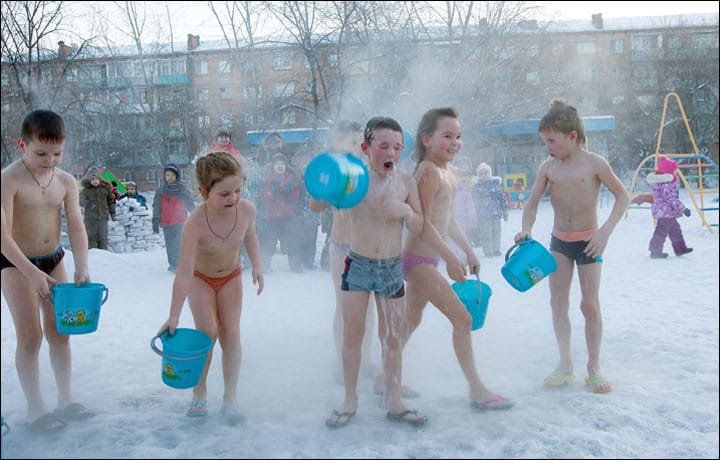
According to the kindergarten, a daily dousing with a bucket of ice-cold water 'helps ward off winter sicknesses and instills optimism in children'.
'Kids who participate in the icy showers tend to be more rational, well-adjusted, and cheerful.' Image: Vera Salnitskaya
Oksana Kabotko, a 41-year-old preschool instructor and swimming coach, firmly believes that a bucket of freezing water benefits her pupils aged three to six. This practice is integrated into the daily schedule at Sibiryachok (Little Siberian) state kindergarten No. 317 in Krasnoyarsk, though participation is optional.
She explained, 'We only do the cold shower when the temperature is at least -25°C. However, this year on Epiphany Day, we went ahead at -30°C, with parents joining in.'
It's a Russian tradition to plunge into icy water on this significant Christian holiday, commemorating Jesus's baptism in the Jordan River, irrespective of how cold it is outside. Winter temperatures in Krasnoyarsk fluctuate; today it was relatively warm at just -10°C.
Oksana asserted that the ice bucket practice is not harmful but beneficial in numerous ways, calling it a 'medical fact' supported by many Siberian doctors.
'But picture this: you have to do it every morning, and that demands real willpower,' she said. Image: Vera Salnitskaya
'Naturally, there are differing opinions, and it's very individual, but it's monitored by a pediatrician,' she noted, sharing her own observations on kids who undergo the ice bucket 'treatment' versus those who don't.
She also mentioned that at one point, Japanese media reportedly refused to publish images of these daily cold showers, considering them cruel to children. In her view, the opposite is true.
'Children who take an ice-cold shower daily—not just once every two weeks—attend kindergarten regularly,' she said. 'Sure, they might catch a winter illness, but it clears up faster, with just a few days at home. Those who skip the ice shower can be home recovering for up to two weeks.'
'Kids who do the ice showers are also more sensible, balanced, and optimistic. They're better organized. But imagine having to do it every morning—it takes willpower. We never force anyone. Some children who don't attend our kindergarten come just for the shower.'
'Before the ice-cold shower, the children warm up in the banya (steam sauna),' she explained. Image: Vera Salnitskaya
Alumni also participate in the invigorating 8 a.m. ritual, as once it becomes a habit, you feel you can't do without it.
Groups proceed in order of age: youngest first, then middle, then oldest, wearing swimsuits or underwear. 'Regulars can't live without it—it becomes a vital part of their lifestyle,' said Oksana. They first spend time in the steam sauna to heat up before dousing.
Staff set up the ice buckets outside, arranged in a row on the snow. 'Kids dash from the banya. Some wear flip-flops, others go barefoot,' she said. 'Sometimes they run around outside for a bit—about 20 meters in the open air. First they wash their faces, then take the shower. Some pour water over their heads, others over their chests.'
'The kids truly enjoy their showers. They queue up to say how much they love it. The younger ones run faster and shout louder. The older ones stroll as if walking a red carpet, acting as if it's not cold. Some choose to shower indoors instead of outside.'
The daily ice bucket routine at the Krasnoyarsk kindergarten. Images: Vera Salnitskaya
Oksana said: 'At the start of the school year, we discuss with parents the idea of their children taking an ice-cold shower outdoors. They must sign consent forms.'
'In the 1990s, such programs were widespread—but now we're the only kindergarten that still offers an outdoor 'street shower,' though others have indoor versions.'
'Initially, in 1998, our staff began taking the ice-cold shower, then they started including their own children. Later, parents were invited to join. Some parents of our current pupils themselves participated as children.'
The kindergarten has about 150 children. 'Typically, when we start in September, many children—around 70—take part,' she said.
'By winter, half of them drop out because it's quite demanding: you have to do it daily, and you need to be in the right frame of mind. In fact, you have to do it regardless of your mood.'
'I must say it's very invigorating and, more importantly, it's excellent for stress relief.' Images: Vera Salnitskaya
The youngest kids—three-year-olds—only go outside for this ritual in March, when the snow begins to thaw. 'Four- and five-year-olds take the ice-cold shower from autumn all through winter,' she said.
'When we start the program, the water is usually around 30°C, then we gradually lower it based on the outside temperature and how the children are feeling.'
By midwinter, the water is as cold as possible. After the shower, the children dry themselves, get dressed, and return to class. 'It's not cold—I feel warm,' said one little boy named Sergei. 'It's thrilling,' added Alina.
Oksana said: 'When we first began, curious onlookers would lean over the fence just to watch the kids shower with cold water. Now we're just part of the scenery.'
Advocates of cold therapy point to a 1997 study in Sochi by Dr. V. Kharitonov, in which blood samples from students were analyzed before and after they poured buckets of cold water over their heads. The study found 'statistically significant' changes in most indicators related to the cellular immune system.
Another proponent of this method is Olesya Osintseva, an experienced kindergarten director in Barnaul.
'Four- and five-year-olds take the ice-cold shower from autumn through winter.' Images: Vera Salnitskaya
When The Siberian Times interviewed her several years ago, she explained that the previous issue of winter illnesses among children dropped dramatically after the ice bucket routine was introduced.
'They were getting the flu, and sometimes half the kindergarten was sick,' she said. 'It was clear we had to do something to make them stronger and more resistant to viruses. That's how we hit on the idea of boosting their immunity by using buckets of cold water outdoors.'
'We first tested it on ourselves and our own kids: adults and children would go outside and splash water on their feet, and after a few months, we progressed to pouring a bucket of cold water over our heads.'
'After six months of these water exercises, we saw an immediate increase in resistance to illnesses. Our children could attend kindergarten even when someone was infected, and they wouldn't catch it.'
'Our doctor confirms that children in groups that practice cold dousing get through flu season much more easily.' Images: Vera Salnitskaya
'Then we took the next step and shared our experience with other parents. Some were anxious about their kids showering with cold water in the dead of winter; others were eager to try.'
'Now the kindergarten has a separate group where all children start the cold water bucket routine from as young as two. I am absolutely certain: these children are noticeably healthier.'
Teacher Lyubov Daniltsova added: 'Maybe people won't believe us, but facts are difficult to dispute. Our doctor confirms that children in dousing groups handle flu season much better, and overall statistics show 95% of children in the 'wet' group are healthy, compared to 75% in the other groups.'
By Olga Gertcyk and Vera Salnitskaya
Source