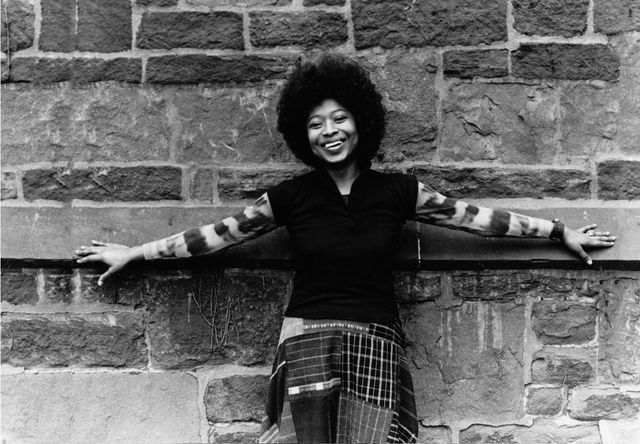
Award-winning novelist, activist, educator, and poet Alice Walker is an undeniable powerhouse. She is most famous for her novel The Color Purple (1982), which earned both the National Book Award and the Pulitzer Prize. The story was adapted into a 1985 film directed by Steven Spielberg, featuring Whoopi Goldberg and Oprah Winfrey, and later became a Broadway musical that ran from 2005 to 2008 and again from 2015 to 2017.
Before she became a celebrated author or civil rights advocate, she was simply a child growing up in the Jim Crow South. Born on February 9, 1944, in Putnam County, Georgia, Alice Walker was the eighth and youngest child of Willie Lee Walker and Minnie Lou Tallulah Grant. Her father worked as a sharecropper and dairy farmer, while her mother was a maid. Defying racist norms, her parents enrolled her in first grade at just four years old. She began writing stories at age eight, and by 13, after an accident left her blind in one eye and led to teasing from other children, she turned to reading and writing poetry. A surgery at 14 removed the scar tissue over her eye, allowing her to rise to the top of her class, but the traumatic injury forever changed her perspective on human relationships.
Writing remained a therapeutic outlet for Walker. Her first poetry collection, Once (1968), was written during her senior year at Sarah Lawrence while studying abroad in East Africa. The poems address her battles with depression and suicidal thoughts. While in college, she became a passionate supporter of the Civil Rights movement, and after graduating, she moved to Mississippi in 1966 to participate in voter registration drives and campaigns for welfare rights and children’s programs.
In the 1970s, Walker returned to writing full-time, publishing her debut novel, The Third Life of Grange Copeland, in 1970. She became an editor at Ms. magazine in 1973. Her second novel, Meridian (1976), is a semi-autobiographical story about her Civil Rights involvement. She continued to earn acclaim, releasing The Color Purple in 1982 and co-founding the feminist publishing house Wild Tree Press in California in 1984. In 2013, she published two books: The Cushion in the Road: Meditation and Wandering as the Whole World Awakens to Being in Harm’s Way and The World Will Follow Joy Turning Madness into Flowers (New Poems). Her work consistently explores themes of racism, sexism, violence, and the struggles of Black women. She remains a key figure in feminist activism, championing the rights of people of color, women, and those oppressed by unjust systems.
We honor her legacy and celebrate her birthday with these photos and quotes:
“The more I wonder, the more I love.”
“We are a people. A people do not throw their geniuses away. And if they are thrown away, it is our duty as artists and as witnesses for the future to collect them again for the sake of our children, and if necessary, bone by bone.”
“Why any woman give a shit what people think is a mystery to me.”
“Keep in mind always the present you are constructing. It should be the future you want.”
“I believe in movements, collective action to influence the future.”
“The most common way people give up their power is by thinking they don’t have any.”
“Truly the suffering is great, here on earth. We blunder along, shredded by our mistakes, bludgeoned by our faults. Not having a clue where the dark path leads us. But on the whole, we stumble along bravely.”
“Be nobody’s darling; Be an outcast. Take the contradictions Of your life and wrap around you like a shawl, to parry stones, to keep you warm.”
“Deliver me from writers who say the way they live doesn’t matter. I’m not sure a bad person can write a good book. If art doesn’t make us better, then what on earth is it for.”
“Laughter isn’t even the other side of tears. It is tears turned inside out.”
“In nature, nothing is perfect, and everything is perfect. Trees can be contorted, bent in weird ways, and they’re still beautiful.”
“Part of what existence means to me is knowing the difference between what I am now and what I was then.”
“Don’t wait around for other people to be happy for you. Any happiness you get you’ve got to make yourself.”
“No person is your friend who demands your silence or denies your right to grow.”
“As long as the Earth can make a spring every year, I can. As long as the Earth can flower and produce nurturing fruit, I can, because I’m the Earth. I won’t give up until the Earth gives up.”
More from BUST
42 Aretha Franklin Quotes And Photos To Mark Her Retirement
23 Audre Lorde Photos And Quotes To Celebrate The BAMF She Was
20 Helen Gurley Brown Quotes And Photos To Remind You That Women Are Incredible
Cricket Epstein is BUST’s editorial intern. She writes about feminism, films, witches, and all things awesome (and terrible). She is currently working on a health and wellness website and podcast, to be launched in the near future. You can follow her on instagram @t0tally_buggin and at her poorly maintained doodlegram @poorly_drawn_puns.