When we see the same item in pink and blue, we instantly label one for girls and the other for boys. Society often assumes that from birth, people are drawn to specific shades based on gender, and dressing children in "opposite" colors is still considered odd. But this wasn't always the case. "GoSeekNest" investigates why girls once wore blue, boys wore pink, and how stereotypes were imposed on the world. Why did the world split colors by gender?
Blue for girls
The division into "male" and "female" colors emerged relatively recently—only by the mid-20th century. Before that, no one paid much attention to the hues of children's clothing. Infants of both sexes were often dressed in white cotton dresses, which were easy to bleach during washing.
Blue and pink, however, had no gender association; they were seen as colors of youth and freshness. Blue, for instance, carried religious significance: in sculpture, painting, and icons, the Virgin Mary was depicted in blue robes symbolizing purity. Consequently, girls' clothing was mostly blue. Boys, in contrast, wore pink as a milder version of red, representing masculinity and strength.
In 1927, Time magazine published a color chart from leading US retail chains indicating which shades best suited each gender. Boston's Filene's, New York's Best & Co, Cleveland's Halle's, and Chicago's Marshall Field all recommended pink for boys and blue for girls.
This was, of course, a marketing ploy. Parents with children of both sexes had to buy new, "appropriate" color sets of clothes, accessories, and toys for each child. In "respectable families," brothers could no longer inherit sisters' hand-me-downs, and vice versa.
Color of freedom
After World War II, the modern perception of gendered colors took hold in the West. However, the exact date and reasons for this shift remain unclear. In the late 1940s, clothing manufacturers suddenly declared that boys prefer blue and girls prefer pink, and began producing collections accordingly.
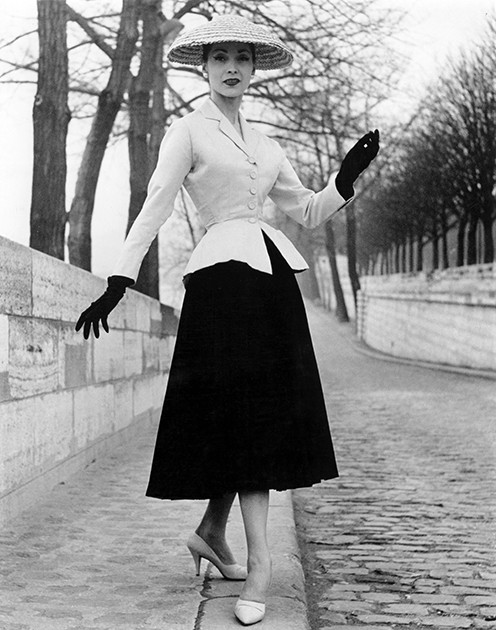
In 1947, the French fashion house Dior launched a radically new female silhouette—the New Look—a stark contrast to the shapeless wartime uniforms. Christian Dior's designs highlighted feminine curves, emphasizing a slim waist and delicate shoulders. These outfits were the complete opposite of the working woman who toiled in factories while her husband fought at the front. Though society criticized the designer for his audacity, his collections gained fans worldwide.
Shutterstock / REX
Once again, marketing departments of children's clothing companies were shrewd. They proposed a new trick: children's clothing silhouettes now mirrored adult cuts. Girls were dressed in delicate, fitted dresses, while boys wore wide trousers and shirts like their fathers. As a result, siblings again needed separate wardrobes, boosting retailer sales.
In the early 1950s, fashion magazines introduced another innovation: pink was suddenly hailed as a symbol of freedom. Women were encouraged to wear pink and red to mark the end of the war. Tired of drab gray "soldier" attire, they eagerly adopted the trend.
In a barbie world
One trendsetter for pink was Mamie Eisenhower, wife of the 34th U.S. President Dwight Eisenhower. At his 1953 inauguration, she appeared in a stunning pink dress, causing a sensation among Americans. She continued to wear pink frequently, and across the country, women snapped up pink items for themselves and their daughters.
A few years later, a doll was created that would become the world's best-selling toy. Barbie—a sensation in girls' toys and a role model for their mothers—lived in a pink house, used pink furniture, drove a pink car, and adored everything pink.
Bettmann / Contributor / Getty Images
Around the same time, the musical Funny Face featured a fashion magazine editor who dedicates an entire ode to pink. In her song, she calls it the color of modern women and contrasts it with gloomy military colors, urging people to erase the war years.
But pink's position as the "female" color was cemented in the early 1960s. In American minds, all pink-covered publications at newsstands were for women, all pink goods in stores were for women, and any advertisement with pink tones targeted women. Advertisers exploited the trend: on any magazine page, you'd likely see an illustration of a girl in a pink dress with pink lips and manicure, standing against a pink car or holding a pink phone.
No longer the weaker gender
Soon, however, the "pink boom" faded. In the 1970s, during the second wave of feminism, women abandoned sugary pink items, fitted dresses, and heels. Having achieved full equality and the elimination of discrimination (the UN established a corresponding convention in 1979), they increasingly wore men's pants, shorts, and business suits. The once-beloved pink was left to very young girls and Barbie.
Over time, love for pink waned, sometimes flaring up again. Women either rejected being seen as the weaker sex or deliberately extended their femininity. Although many women-focused fashion brands still use pink for advertising (Victoria's Secret even has a line called Pink), in modern society, pink is often considered the "color of blondes," naivety, or even frivolity.
Today, color prejudices remain so strong that a two-year-old child who appears male but wears a pink jumpsuit will be perceived as a girl.
Pink gene
Numerous studies have explored when children begin to associate their gender with pink or blue. Many show that children of both sexes prefer blue over other colors, and hardly confirm an innate preference for pink in girls. Another experiment, published in the British Journal of Developmental Psychology, revealed not only a trend in color preferences but also the exact age of their formation.
The study involved children aged seven months to five years. Each child was offered eight pairs of objects in different colors, with one pink object in each pair. Results showed that by age two, girls preferred pink objects much more often than boys, and by two and a half, they almost always chose pink from two objects. Boys, in contrast, actively avoided pink. The older the boy, the fewer pink items appeared in his collection.
Another hypothesis suggests that preferences for "male" and "female" colors have ancient roots. When men hunted and women gathered, the blue sky signaled favorable hunting conditions, while red and its shades indicated ripe berries. Regardless of whether color preferences are genetic, companies have long learned to manipulate nature for profit.
Featured image on