Explore the city of Pripyat and the 30-kilometer exclusion zone surrounding the Chernobyl Nuclear Power Plant tragedy.
Video by Jellyfish Pictures
32 years have elapsed, with 19,968 years still needed for the complete decay of radiation.
Within the NPP's 30-kilometer zone: strontium-90 (half-life ~29 years), cesium-137 (half-life ~30 years), americium-241 (half-life ~432 years), plutonium-239 (half-life ~24,110 years).
The sole child born in Chernobyl after the catastrophe is Maria Sovenko. Now 19, she finished school in Ivankovo and moved to the capital for university. “The girl has a bold character, just like Chernobyl,” jokes a neighbor. Maria wasn't a top student, but she managed to gain admission to a university in Kyiv. She returns to her mother's home during holidays. A Ukrainian TV channel video shows her mother holding her as an infant in 1999. Her birth was considered unbelievable; a local doctor told the pregnant woman, then 46 and living permanently in the closed Chernobyl zone, that pregnancy was impossible. So until labor, she believed she was gravely ill. Her birth certificate lists Chernobyl as the place of birth—a unique document after the 1986 accident. Maria was examined by numerous doctors before her first birthday, and all concluded: healthy!
Residents of the exclusion zone firmly believe that the vegetables, fruits, and water there are completely safe. They told a journalist from segodnya.ua that those pensioners who were relocated far away have long since died, while those who stayed are still alive. “We eat everything, even fish,” they say. “The fish have no badges or passes; they don't ask where to swim.” In the pond next to the reactor cooling system near the station, there is plenty of fish. The bottom is checked weekly and remains clean. Scientists tell us: “99% of the fish is pure, but 1% contains the entire periodic table—you can only guess if you're lucky.” Nature fights against adversity; the key for humans is to stop interfering further.
After the accident, a new icon was painted and given to the local church, named “Chernobyl Salvation.” The image appeared multiple times in the dreams of Yuri Andreev, a former CHNPP worker, atheist, and stage 4 cancer patient. Upon learning of this, Patriarch Vladimir blessed the newly painted icon based on Andreev's dreams. When the icon was consecrated in the Kyiv Pechersk Lavra, a sign appeared—a clear rainbow in a cloudless sky. Yuri was healed of cancer and lived another 10 years.
Also Read: Traveling to Ukraine
Father Pavel recalls that the accident occurred during Holy Week, from Friday to Saturday, two days before Easter. “People came to the church seeking answers, even those who had never entered it before,” he says. “Unfortunately, we are always closer to God only when trouble strikes. Interestingly, after the explosion, the radiation level in the Elias Church was the lowest: God protected those who sought his shelter. So this place is special, and it has its own Easter.”
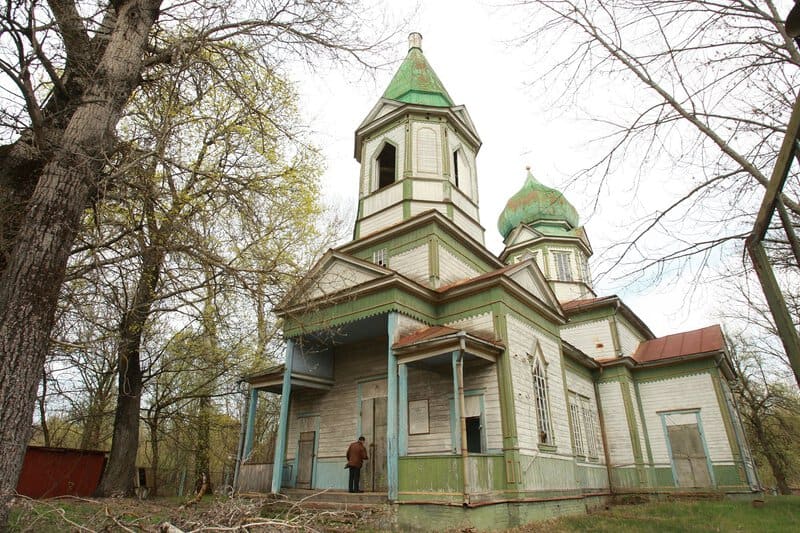
40 kilometers from the Elijah Church in Chernobyl stands the ancient Temple of Archangel Michael. Despite the short distance, one must drive extremely slowly on the broken road for an hour, dodging potholes. St. Michael's Temple lies on the “dirty” territory of the exclusion zone: in 1986, until mid-May, the wind blew the radioactive cloud in that direction.
Chernobyl's sacred site. The wooden church with its belfry dates back to the year 1800.
Sacrilege. Thieves managed to cut out even the icons in the dome.
It may sound crazy to outsiders and Ukrainians, but residents are certain that one day young people will return to Chernobyl.
As a human race, we can only hope that such tragic accidents will never again occur on the planet we inhabit.
Sources: segodnya.ua, rostov.kp.ru
Written and translated by Fury Princess