News outlets recently buzzed with reports about McDonald's. Did you catch it? Consider these headlines:
CNN Money announced McDonald's is eliminating artificial additives from their burgers. CBS News reported that new recipes remove artificial ingredients. Food & Wine stated McDonald's scraps artificial ingredients in burgers.
That sounds promising, doesn't it? Initially, I was quite curious.
However, after some investigation, I became frustrated with these reports.
Such headlines might trick people into thinking McDonald's has overhauled its menu and now serves food free of artificial ingredients. But as I'll show, that's far from accurate.
The real facts about McDonald's menu
High fructose corn syrup remains present in every classic McDonald's burger.
The chain hasn't eliminated high fructose corn syrup from the ketchup or Big Mac Sauce used on those burgers.
And that's not the only detail these reports omitted.
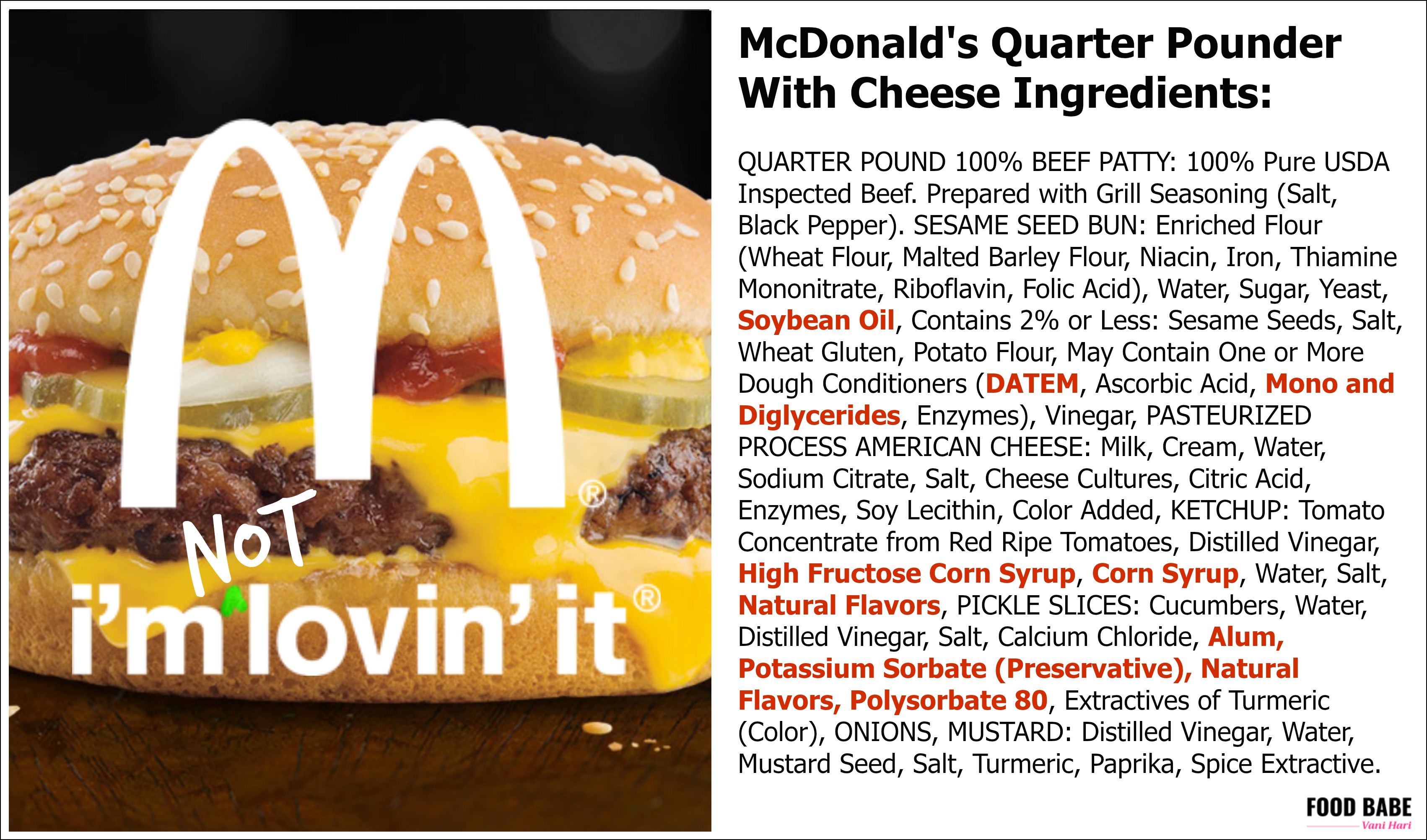
McDonald's so-called "new" ingredient list reads like a catalog of additives to steer clear of. Artificial colors, flavors, emulsifiers, and preservatives still heavily dominate their offerings.
Take the buns: they include two synthetic emulsifiers
I've previously discussed the artificial emulsifiers DATEM and mono- and diglycerides. These substances aren't entirely safe since they may harbor trans fats. Trans fats are associated with heart disease, and the CDC estimates they cause up to 7,000 coronary heart disease deaths annually in the United States.
These synthetic emulsifiers appear in nearly every McDonald's sandwich: the Quarter Pounder, Big Mac, Cheeseburger, Hamburger, McChicken, McMuffins—basically any sandwich served on a sesame seed bun, regular bun, English muffin, or artisan roll.
The pickles on most McDonald's burgers contain Polysorbate 80, an emulsifier. A 2015 study connected Polysorbate 80 to substantial weight gain and inflammatory bowel disease. Pickles don't need this additive—the ones I purchase certainly lack it. Additionally, these pickles are artificially preserved with Potassium Sorbate, which some research indicates may be genotoxic to white blood cells.
Caramel color remains in the iconic Big Mac Sauce
McDonald's can claim it uses no "artificial colors" because the industry classifies caramel color as "natural"—but I disagree. Caramel color is typically manufactured in a lab by reacting corn sugar with ammonia and sulfites under high pressure and heat. This process generates the byproduct 4-Mel. A U.S. government-funded study showed that feeding mice caramel color IV (containing 4-Mel) raised their risk of lung cancer and leukemia at every dose. The International Agency for Research on Cancer labels 4-Mel as "possibly carcinogenic to humans."
To be fair, safer versions of caramel color exist. That's why I initially gave McDonald's the benefit of the doubt and inquired about the type they use. Their response: the information is "proprietary and not available." (I'll let you judge whether they opt for a safer variety after that reply.)
Ultimately, caramel color is completely unnecessary and potentially hazardous. Its sole purpose is to impart a brown hue—does McDonald's truly need to tint their "special sauce" brown to satisfy customers? I doubt it. This is the same additive we urged Starbucks to eliminate from their beverages—and they complied. If Starbucks can manage it, McDonald's certainly can as well.
Admittedly, McDonald's has eliminated some harmful additives in recent years
When I looked into McDonald's in 2015, they included the artificial preservative BHA in ten menu items. BHA is now gone. Propyl gallate and TBHQ have also been removed. The artificial dough conditioner azodicarbonamide (often called the "yoga mat" ingredient) was present in nearly all buns—now it appears in only one (a "bakery style bun" used in some locations, not a core item). These are significant improvements.
However, McDonald's hasn't removed artificial colors from their burgers
...and that's because their burgers never contained artificial colors in the first place.
McDonald's primarily adds artificial dyes—such as Yellow 5, Yellow 6, Red 40, and Blue 1—to certain shakes and the Frappe Mocha. They continue to do so.
Artificial dyes appear in McDonald's EggNog Shake, Shamrock Shake, and Frappe Mochas. As I've repeatedly noted, these dyes come from petroleum and are associated with health problems from cancer to behavioral issues in children. They don't belong in our food.
Despite the headlines, McDonald's menu remains packed with artificial and questionable additives
- Sodium phosphate, a synthetic preservative, remains in all McDonald's bacon burgers and McChicken sandwiches. Frequent consumption may increase the risk of kidney disorders and heart disease.
- Carrageenan, a thickener and emulsifier associated with digestive problems and cancer, is present in McDonald's biscuits, ice cream, shakes, and iced coffee.
- Many McDonald's sauces and bagels are sweetened with high fructose corn syrup, a heavily processed sweetener derived from GMO corn. Research indicates this sweetener contributes more to obesity and type 2 diabetes than regular cane sugar (sucrose).
- Caramel color—an unnecessary coloring agent linked to cancer—appears on the Big Mac, as well as in McGriddles breakfast sandwiches, Vanilla Shakes, and Oatmeal.
- The shredded cheese on McDonald's salads is coated with cellulose, an additive sourced from wood that has been linked to intestinal inflammation, inflammatory bowel disease, and "significant" weight gain.
- Chicken McNuggets and the Bacon Smokehouse Burger contain yeast extract, a hidden form of MSG. Additional hidden MSG appears as hydrolyzed proteins in the Big Mac Sauce. These additives serve as cleaner-sounding substitutes for MSG but are fundamentally identical.
- Oddly, McDonald's still uses dimethylpolysiloxane, a synthetic defoaming agent, in all U.S. fried foods, despite not using it in the U.K. Curious—they manage to produce fries in the UK without it.
McDonald's can and should improve
McDonald's has once again been named the most popular fast-food chain in the U.S., leading in sales. That means many Americans dine there—even if you personally don't.
Please share this article and alert your friends who still frequent McDonald's
No one should consume these hazardous additives at America's top fast-food chain. Don't you think so?
Xo,
Vani
READ: Understanding the Distinctions Between Artificial, Natural, and Organic Flavors
P.S. If you enjoyed this post, be sure to explore my new book FEEDING YOU LIES (available for pre-order now!). Find it at a local store near you, or at Barnes & Noble or Amazon.
In Feeding You Lies, I reveal the brazen deceptions we're told about our food by those we should trust for health guidance—lies about nutritional content, health impacts, labeling, and even the science behind our dietary choices. It's investigative, hard-hitting, and scandalous. If you appreciate my food investigations, you'll surely enjoy this book. Here's what it includes:
- How food company-funded experts manipulate scientific research about our food
- Previously unseen emails exposing who is secretly receiving payments from the food and chemical industries and what they are paid to do
- How to identify fake news produced by Big Food
- The tactics food corporations employ to make their products addictive
- Understanding why labels such as "all natural" and "non-GMO" are misleading and how to choose the healthiest options
- Food marketing scams that trick us into purchasing junk food masquerading as health food
- The "Three Question Detox" method to enhance every food decision you make
- A simple "48-Hour Toxin Takedown" plan to dodge chemical exposure while getting healthier
Want to be among the first to read it? Pre-order your copy now. Find it locally near you here, or at Barnes & Noble or Amazon.
This post may include affiliate, sponsorship, or partnership links for products that Food Babe has personally vetted and researched. If you buy a product through such a link, your price remains the same (or may be discounted with a special code), and Food Babe receives a commission. Your support is vital—it helps fund this blog and allows us to keep spreading the message. Thank you.