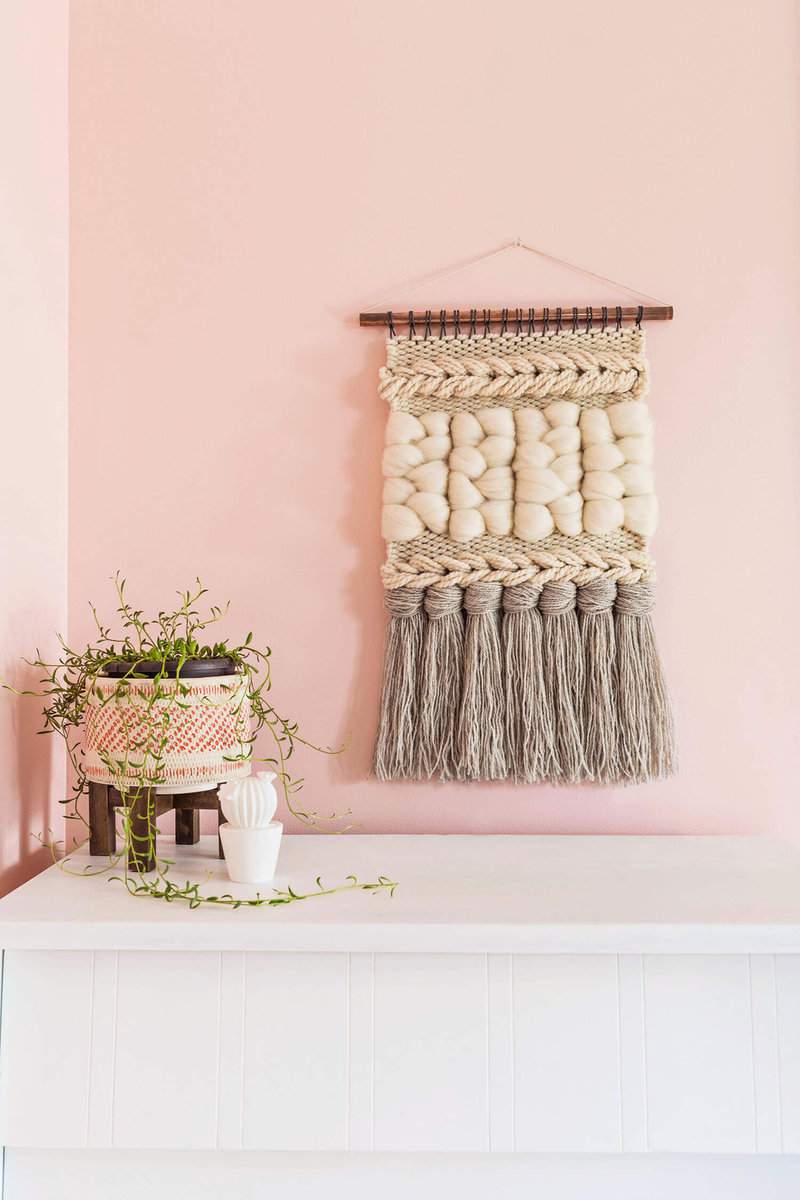
The name of this guide might be slightly deceptive, since weaving is seldom a speedy endeavor. But if you've been eager to craft your own textured tapestry without dedicating five hours to the task, this project is perfect for you. By employing bulky yarns and the stitches outlined here, you can populate your loom in less than half the typical time needed for a medium-sized wall piece. This design is easily adaptable to match your home's palette or would make a wonderful housewarming present. Read on to learn how to create your own!
Materials – Lap loom (mine measures 13" x 18") – Weaving sword or ruler – One skein of super bulky cream yarn (90+ yards) – One skein of neutral, worsted-weight yarn for the bottom fringe (140+ yards) – 8 oz of merino wool roving – Cotton yarn for warp – Scissors – 3" tapestry needle
Step One: Set Up Your Loom
Warp your loom so you utilize the entire width. Begin and end your knots on the bottom of the loom to ensure an even number of warp rows. New to warping? No problem—refer to this beginner guide for detailed instructions. After warping, weave four rows of plain weave to create a base before adding rya knots. If you're unfamiliar with plain weave, check that same beginner tutorial for the steps.
Step Two: Prepare Extra-Thick Rya Knots
Cut roughly 20 strands of your neutral worsted-weight yarn, each about 20" long. They don't need to be perfectly even since you'll trim them later. I made one rya knot bundle for every five warp rows. I had 34 warp rows instead of 35, so I improvised on one. If your loom is narrower, adjust accordingly.
Step Three: Position the First Bundle
Find the center of your first rya knot bundle and place it on top of the warp rows. Wrap the end nearest the outer warp row completely around it as shown.
Step Four: Continue the Wrap
Skip the next two warp rows, then wrap the other end of your bundle fully around the fourth warp row. The two ends should wrap toward each other and then away.
Step Five: Secure the Rya Knot
Pull the bundle ends toward each other, adjust so they're centered, and gently tug downward. Your rya 'knot' should rest lightly on top of the plain weave base from step one.
Step Six: Repeat Across the Loom
Skip the fifth warp row and then repeat. So your next bundle wraps around the sixth warp row, skips the seventh and eighth, then wraps the opposite way around the ninth. When finished, you'll have a lovely chunky fringe.
Step Seven: Start the Soumak Stitch
The next stitch, soumak, creates a braided effect. Using a single strand works, but using five strands adds plenty of texture and fills space faster. This weave is all about going big!
Cut five strands of chunky yarn, each about 8' long. Tuck one end between the outer warp row and the adjacent row, leaving a 4" tail on the back side of your warp.
Step Eight: Begin the Soumak Wrap
Wrap all five strands together around that outer warp row and bring them back up between the outer warp row and the second warp row as shown.
Step Nine: Continue the Pattern
Skip two warp rows, then wrap the entire bunch (all five strands together) over the top and around the fourth warp row. Always pull it up above your wrap to keep things consistent.
Step Ten: Maintain the Skip-Wrap Sequence
Keep skipping two warp rows and wrapping around the next one. You should see a stair-step pattern forming.
Step Eleven: Adjust Tension
Gently push your stair-step pattern down so it rests on top of the rya knots. Adjust tension to ensure consistent spacing. Notice how they all slant the same direction? When you reach the opposite end, wrap your bunch around the outer warp row twice to build height for the next row.
Step Twelve: Reverse Direction for Braid Effect
When continuing soumak in the opposite direction, still skip two warp rows and wrap over the top of the next warp row. You'll see it start slanting opposite to the first row, creating a braided pattern. When you return to the start, tuck the tail ends around the outer row and pretend you're starting a regular weft row by going over then under. This tucks your ends behind the warp again. Trim to leave a 4" tail.
Step Thirteen: Prepare for Figure-Eight Weaving
Count your warp rows and divide by eight. For this section, you'll weave figure eights with wool roving. Each braided section will be split in half, with four warp rows on each side. If you have an extra warp row or two, add them to a batch of four somewhere. Use about 24" of roving per braided section.
Starting on the left side of your loom, tuck about 3" of roving down between the fourth and fifth warp rows. Then wrap the long end of your roving completely around the four warp rows closest to the edge and back up between the fourth and fifth warp rows.
Step Fourteen: Form the Vertical Braid
Wrap your roving over warp rows 5–8 and back between the fourth and fifth warp rows. Essentially, you're wrapping around the first four warp rows, then the next four, back and forth to create a vertical braid.
Step Fifteen: Finish Evenly
End with an even braid—meaning you've wrapped around both sections of warp rows an equal number of times. Then tuck your tail up between the sixth and fifth warp rows, then back down between the fifth and fourth. This weaves in the tail securely without it showing.
Step Sixteen: Repeat Braids Across
Braids on your first vertical row determine the count for the rest. Feel free to fluff them for consistency. This section takes up a lot of warp space and adds great texture—and the best part is it weaves quickly!
Step Seventeen: Add Plain Weave and More Soumak
Add a section of plain weave above your braided roving rows. I added about 10 weft rows (each horizontal row is a weft row). Then add two more rows of soumak using the same length and amount from step seven. This keeps the design balanced and consistent. Finally, frame the other side of your soumak with 10 or 12 additional weft rows of plain weave in the same chunky yarn.
Step Eighteen: Remove from Loom
You may not want to weave all the way to the top of your loom. No problem! Gently pull individual pairs of warp rows off the top notches. Create a lark's knot by folding the warp yarn back behind itself.
Step Nineteen: Attach Hanging Rod
Bring the two loops together in front, then slip this loop over your copper pipe or wooden dowel. Do this one at a time without pulling the warp rows too much—you don't want things shifting as you remove it from the loom. Then gently pull it off the bottom of the loom. Tie each bottom loop into a small knot to prevent shifting downward.
Step Twenty: Add Hanger and Finish
Once the pipe is in place, add a hanger by slipping a 3' length of cotton yarn through the pipe. Tie a double knot and hide the knot somewhere in the center of the pipe. Flip your wall hanging over and tuck the soumak tails behind the exposed warp rows. Trim the roving tails so they aren't too fluffy—they'll stay put.
After finishing any wall hanging, I like to hang it on a hook and brush through the rya knots with my fingers or a weaving comb to straighten things out. Then I trim the scraggly ends for a more polished look. Congratulations! You've completed a beautiful wall hanging in half the usual time, thanks to using the chunkiest fibers!
Find the perfect spot for your wall hanging and enjoy! – Rachel
Want to learn more about weaving or try more complex designs? Check out my book, DIY Woven Art, which features 15 projects ranging from the most basic to weaving your own rug—no joke.